 844 408 3056

 Hot Deal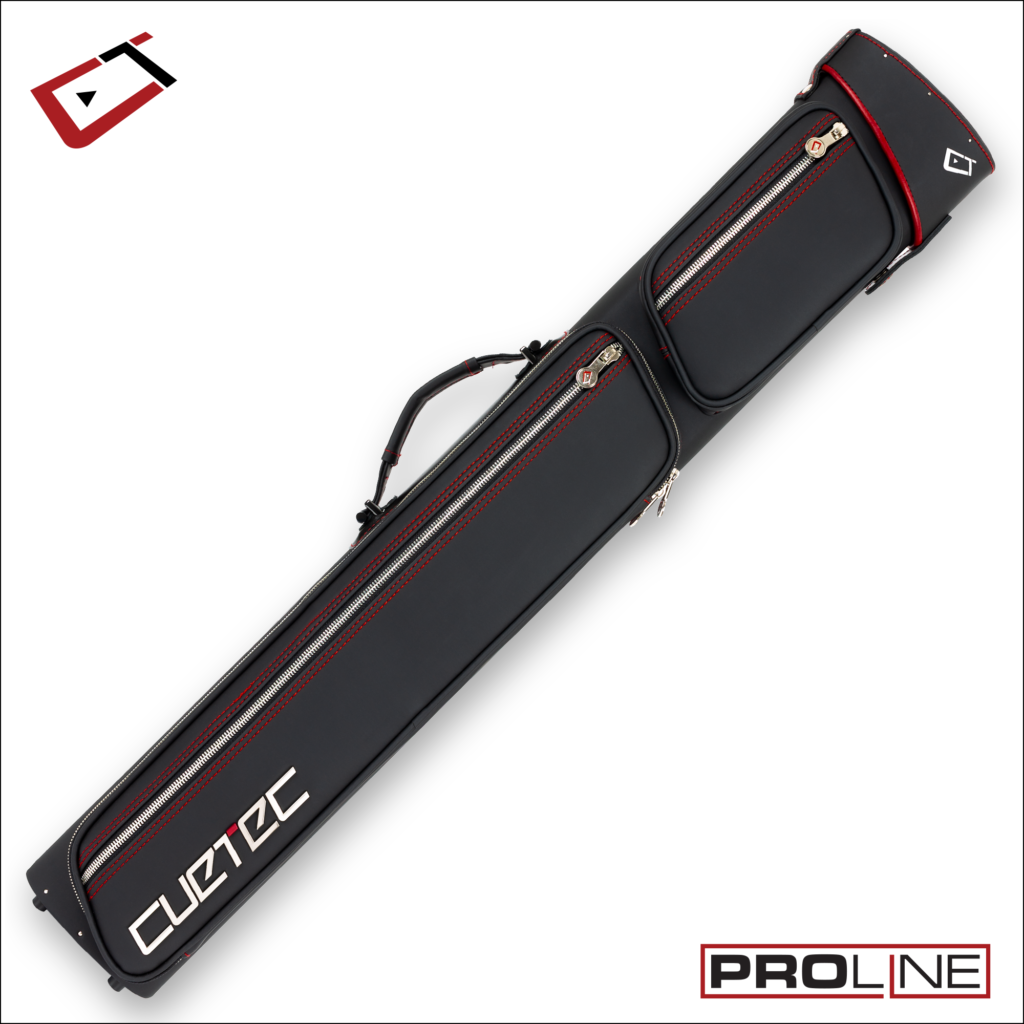
Cuetec built its reputation on the playing cue, but the case program has quietly become one of the most coherent in the industry. The Pro Line cases are designed to sit alongside Cuetec’s modern fiberglass and Cynergy carbon shafts, which means the look is technical, the materials are contemporary, and the build is dialed in for the working player rather than the collector. If you have been scrolling through the wider pool cue cases collection, the Cuetec Cases category is where to land if your aesthetic leans modern rather than traditional leather.
A note on case sizing before we dig in. Cases get labeled with two numbers, like 2B 4S, 3B 5S, or 4B 8S. The first number is butts, the second is shafts. A 2×4 fits two complete cues with two extra shafts. A 3×5 carries three full cues plus two extras, which is the standard tournament loadout: playing cue, break cue, and jump cue with a spare break shaft and a spare playing shaft. A 4×8 is for the player who travels heavy and wants room to grow. Cuetec offers all three sizes in the same color families, which is rare and convenient.
What makes Cuetec cases different
Two things separate the Cuetec Pro Line from most cases at this price. First, the materials match the brand’s cue line. The exteriors use modern technical fabrics with reinforced panels, contrast stitching, and color treatments (Black, Navy, Speed Grey, Ghost) that carry across the entire case range. Buy a 2×4 today and a 4×8 next year and they will visually belong together. Second, the construction is genuinely dialed for transport rather than display. The hard cases use molded interior tubes for cue protection, the soft cases use heavily padded interior dividers, and every case in this lineup ships with both a top handle and a removable padded shoulder strap.
Pricing is another reason these cases have a following. Most of the line lands between $349 and $409, which is half the cost of comparable leather tournament cases while delivering equal or better real-world protection. For a player who treats a case as a tool rather than a status piece, that math is hard to argue with.
Three Cuetec cases worth your attention in 2026
1. Cuetec Pro Line Black 2×4 Hard Case (CTCP24 BLACK)
The Cuetec Pro Line 2×4 Hard Case in Black at $349 is the workhorse of the lineup. Two butts, four shafts, hard-shell construction, molded tube interior. This is the case I would put on the table for any league player who runs one playing cue and one break cue and wants room for spare shafts.
The all-black colorway is the most versatile of the three available finishes. It pairs cleanly with any cue you are likely to drop into it, and the Cuetec branding is subtle enough that it does not announce itself across a poolroom. If you have been carrying your cues in a soft tube case and are ready to upgrade to real impact protection, this is the one.
2. Cuetec CTCP35 3×5 Soft Case Navy
Step up to the Cuetec CTCP35 3×5 Soft Case in Navy at $369 and you move into tournament territory. Three butts and five shafts gives you space for a playing cue, a dedicated break cue, a jump cue, and spare shafts for at least two of those. The navy body with red contrast stitching is the most photogenic option in the lineup and looks especially good next to a Cuetec Cynergy carbon-shafted playing cue.
This is a soft case, not a hard case, so the protection model is different. Soft cases use thick interior padding plus reinforced exterior panels rather than a rigid molded shell. They are lighter, more flexible to load and unload, and a bit more forgiving in tight transport situations like a packed car trunk. They are not what you want if a case is going to be tossed in a luggage hold, but for car-to-poolroom transport they are excellent.
3. Cuetec Pro Line Navy 4×8 Soft Case (CTCP48 NAVY)
The Cuetec Pro Line 4×8 Soft Case in Navy at $359 is the big-capacity option. Four butts and eight shafts is an enormous loadout, more than most players ever need, but if you are a serious tournament regular who runs multiple shaft setups (low-deflection for safeties, traditional for power) or you teach lessons and carry student cues alongside your own, this is your case.
It is a soft case rather than hard, which keeps the carry weight reasonable even when fully loaded. The padded shoulder strap is genuinely comfortable, which matters when the case is heavy. The same navy treatment as the 3×5 above means if you already own that case, this one will look like its big sibling sitting beside it.
How to choose between them
Capacity is the deciding factor. If you carry one playing cue and one break cue, the 2×4 hard case is enough and gets you maximum impact protection. If you also carry a jump cue or a second playing cue, step to the 3×5. If you teach, travel a tournament circuit, or run multiple shafts per cue, the 4×8 makes sense. Soft versus hard is a secondary call. Hard cases protect against drops and crushing best. Soft cases save weight and pack more flexibly. For most players the 2×4 hard or 3×5 soft is the sweet spot. Browse the full Cuetec Cases collection at Quarter King Billiards to see every color option.

About Corey Bernstein
Corey Bernstein is a competitive pool player, billiards equipment specialist, and co-owner of Quarter King Billiards in Wilmington, North Carolina. With over a decade of experience in the sport, Corey has competed in regional APA and BCA sanctioned tournaments and maintains an intimate knowledge of cue construction, shaft technology, and table mechanics. As a certified dealer for brands including Predator, McDermott, Jacoby, Viking, Lucasi, Meucci, Joss, and Cuetec, Corey personally tests and evaluates every cue that comes through the shop. His hands-on approach to the business means he has racked thousands of hours behind the table — breaking in shafts, comparing tip compounds, and dialing in the nuances that separate a good cue from a great one. When he is not behind the counter or on the table, Corey is researching the latest advances in low-deflection technology, carbon fiber shaft construction, and cue ball physics. His articles on Quarter King Billiards combine real-world playing experience with deep product knowledge to help players at every level find the right equipment for their game.