 844 408 3056

 Hot Deal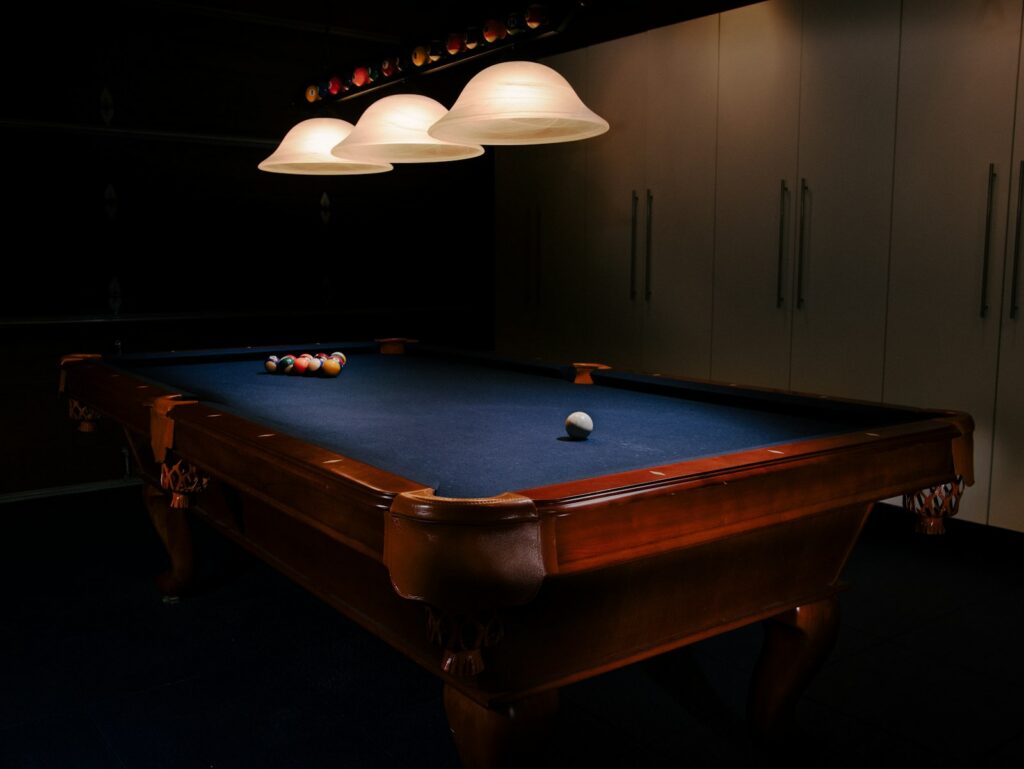
Pool table lighting is one of those purchases that gets put off until the table is in the room and the first game makes it obvious — the ceiling light isn’t enough, the corners are dark, and the cue ball casts a hard shadow on every shot. Good lighting changes the game. It also changes how the room photographs, how the table looks at rest, and whether you actually want to spend evenings down there.
This guide breaks down everything you need to choose pool table lighting that works: hanging height, total light output, fixture types, and what to spend in 2026.
The One Number That Actually Matters: Hanging Height
If you only get one thing right, get this one. The bottom of your pool table light should sit 32 to 36 inches above the slate. Most installers settle on 33 to 34 inches as the sweet spot.
That means the bottom of the fixture is roughly 62 to 66 inches off the floor for a standard pool table (the slate sits about 30 inches high). Anyone over six feet tall will tell you that lower than that gets dangerous on bigger break shots and longer rail-side stances. Higher than that and your light spread gets weak and shadowy near the rails.
The geometry matters because pool lighting is doing something specific: it has to evenly cover a 9-foot table without leaving the rails or pockets in shadow. A fixture that’s too high becomes a single point source that casts long shadows. A fixture that’s too low becomes a single hot spot in the middle of the table.
Total Light Output: Lumens and Wattage
The other number that matters is how much light you’re actually putting on the cloth. The working target for a 9-foot table is 2,000 to 4,000 total lumens distributed across the playing surface, which translates to roughly 120 to 200 watts of incandescent equivalent across the whole fixture. With modern LEDs that means three to five 12-watt bulbs, or a single linear fixture rated for the same total output.
For a 7-foot bar table, you can drop that to around 1,500 to 2,500 lumens. For a 12-watt LED bulb, that’s typically two to four bulbs. Smaller table, less light needed, but still distributed — never a single bulb in the middle.
Color temperature matters too. 3,000K to 4,000K is the right range. Warmer than 2,700K starts to wash out the cloth color and make balls hard to read. Cooler than 5,000K ends up looking like a hospital. If your table cloth is anything other than green (we covered cloth selection in our pool table cloth buyers guide), bias slightly cooler — closer to 4,000K — to keep the colors accurate.
Fixture Types: What Actually Hangs Above Your Table
Pool table lighting comes in four practical formats. Pick based on your room style and the look you want.
Three-Shade Pendant Fixtures
The classic. Three (sometimes four) hanging shades on a single rod, each with its own bulb. This is what most people picture when they hear “pool table light.” It distributes light naturally across the playing surface and looks at home in any traditional billiards room. Brunswick, Olhausen, Diamond, and aftermarket brands all sell three-shade fixtures in glass, stained glass, or metal. Expect $250 to $1,500 depending on shade quality.
Linear Bar Fixtures
A single horizontal housing with an internal LED strip or several bulbs in a row. Modern, minimalist, and easier to wire than a three-shade. Linear bars excel in contemporary game rooms and are the format you see most often in pool halls and pro venues, including Diamond’s tournament lights. Budget $150 to $700 for a quality linear fixture.
Logo or Branded Lights
The bar-style hanging light with a beer or beverage logo printed on the shade. Functional, fun, but only really works if the logo matches the room you’re building. Light output is usually adequate for casual play but rarely tournament-quality. $100 to $300.
Recessed or Track Lighting
Generally a bad idea for pool. Recessed cans and track lights cast hard shadows from above and don’t deliver the diffused, even illumination a playing surface needs. They can supplement a dedicated pool light, but they shouldn’t replace it. If your room only has recessed lighting, you’ll feel the difference immediately when you add a real pool fixture.
Where the Money Goes: Cheap, Mid, and Premium
Pool table lighting price tiers are easier to read than most billiards categories.
Under $200: Generic three-shade pendants, basic linear bars, and most logo lights. Functional, not durable. Glass shades are often thin and chip easily. Wiring junction boxes are entry-grade. Fine for a basement bar table where the table itself was a budget purchase.
$200 to $600: The sweet spot for most home buyers. Solid construction, real glass or quality metal shades, proper junction boxes, dimmable LED options. Brands like Mizerak, RAM, Hathaway, and many house-brand lights from billiards retailers live here. Match this tier to a 7-foot or 8-foot home table.
$600 to $1,500: Brunswick, Olhausen, Diamond, and equivalent. Hand-finished shades, premium materials (stained glass, kiln-fired ceramics, brass hardware), and lighting engineered specifically for tournament-grade visibility. This tier matches a Diamond or Brunswick playing table. We covered why Diamond is the gold standard in our table guide; their lights deserve the same upgrade if you’re going that route.
$1,500 and up: Custom or stained-glass art fixtures, often built to match a specific table or room. Less about playing performance, more about room design. If you’re building the kind of home billiards room we walked through in our home billiards room setup guide, this is where statement lights live.
Installation: What to Do Before the Electrician Arrives
Three things to lock in before any wiring happens:
- Center the fixture on the table, not the room. The light follows the table, not the ceiling. If your table is offset in a long room, your light should be offset too. A common mistake is centering the junction box mid-room and ending up with a light that’s 18 inches off-axis to the playing surface.
- Use a swag chain or canopy if your ceiling junction box isn’t directly over the table. Almost no rooms have the box in the right place by accident. A swag chain lets you mount to an existing box and run the cord laterally to where the light needs to hang.
- Wire it on a dimmer. Pool lighting on a switch alone is a missed opportunity. A dimmable LED setup lets you brighten for serious play and dim for casual nights or a bar atmosphere. If you’re building a room people will actually hang out in — the kind of space we covered in our pool halls as third places piece — a dimmer is the difference between a game room and a real room.
Common Mistakes That Wreck a Setup
A few patterns we see all the time:
- One bulb, dead center. Even with a 200-watt equivalent, a single bulb above the table casts shadows on every shot. Always pick a fixture with at least three light sources distributed across the table’s long axis.
- Wrong color temperature. 2,200K Edison-style bulbs look great in a bar but make the cue ball read yellow and kill ball-color contrast. Save the Edison vibe for accent lighting and put real 3,000-4,000K bulbs in the playing fixture.
- Hanging too high to “keep tall guys safe.” Taller players adjust by ducking on warm-up swings; the cost of a too-high fixture is permanent shadow on every shot. Hang it at 33 inches above slate and trust the geometry.
- Skipping the dimmer. See above. Always, always wire a dimmer.
Bottom Line
You don’t need a $1,500 fixture to play well. You need three things: a fixture with three or more light sources hung 32 to 36 inches above the slate, total output of 2,000 to 4,000 lumens at 3,000K to 4,000K color temperature, and a dimmer on the switch. Get those right and the rest is room style. Get any of them wrong and you’ll feel it on every shot.
If you’re building out a complete room, our home billiards room setup guide walks through everything around the table, and the 7-foot vs 9-foot table guide covers picking the table itself.

About Corey Bernstein
Corey Bernstein is a competitive pool player, billiards equipment specialist, and co-owner of Quarter King Billiards in Wilmington, North Carolina. With over a decade of experience in the sport, Corey has competed in regional APA and BCA sanctioned tournaments and maintains an intimate knowledge of cue construction, shaft technology, and table mechanics. As a certified dealer for brands including Predator, McDermott, Jacoby, Viking, Lucasi, Meucci, Joss, and Cuetec, Corey personally tests and evaluates every cue that comes through the shop. His hands-on approach to the business means he has racked thousands of hours behind the table — breaking in shafts, comparing tip compounds, and dialing in the nuances that separate a good cue from a great one. When he is not behind the counter or on the table, Corey is researching the latest advances in low-deflection technology, carbon fiber shaft construction, and cue ball physics. His articles on Quarter King Billiards combine real-world playing experience with deep product knowledge to help players at every level find the right equipment for their game.