 844 408 3056


 Hot Deal

Moritz Neuhausen keeps finding a way to be the last man standing in Verona. The German closed out Turning Stone Classic XLII on Sunday, September 6 at Turning Stone Casino, collecting the $10,000 first prize from a $46,393 purse that Mike Zuglan’s Joss Northeast 9-Ball Tour boosted with $25,000 in added money. Shaun Wilkie of Havre de Grace, Maryland took second and $6,500, Kevin Clark finished third for $4,000, and Germany’s Boris Ivanovski was fourth. If the names in that top four look like a mix of touring pros and hardened regional grinders, that is exactly what this event has always been, and it is why the lessons from it travel so well to your own league night.
Turning Stone is not a one-weekend event for Neuhausen. He won Classic XXXIX in September 2024, finished runner-up to the field at Classic XL in January 2025, and now owns Classic XLII. Three trips to the final table at the same venue in two years says something about a player who has figured out how to prepare for a specific room, a specific set of tables, and a specific four-day grind. That is a skill, not luck, and it is one that amateur players almost never work on.
How the Field Shook Out
The money list tells a story of depth. Behind the top four, defending January champion John Morra of Toronto tied for fifth with Connecticut’s Lukas Fracasso-Verner, each collecting $2,000. Dylan Spohr and Jayson Shaw tied for seventh at $1,600. Danny Hewitt, Ron Casanzio, Tommy Cayer, and Zion Zvi split the ninth-place money at $1,200 apiece, and Angelo Innes, Brad Guthrie, Dan Mulhollen, and Joe Dupuis rounded out the top sixteen at $950 each. Seven players finished tied for seventeenth at $599, a group that included Rachel Lang and Bryzen Manipula, and eight more cashed $400 for a tie at twenty-fifth.
Count the passports in that top twelve and you get Germany, the United States, Canada, Scotland, and Israel. Morra won Classic XLI in January, so the man who arrived as the defending champion still had to settle for a fifth-place tie. Shaw, a multiple-time Turning Stone champion who remains the standard-bearer for Cuetec, went out in seventh. When players of that caliber are finishing behind a regional name like Kevin Clark, the message is simple: form on the day beats reputation, every time.
Lesson One: Learn the Room Before You Need To
Neuhausen’s record at Turning Stone is a case study in what coaches call venue familiarity. The tables, the cloth speed, the pocket cut, the lighting, even how the rails play after two days of heavy use all become known quantities to a player who has been deep in the event three times. He is not spending his first three matches recalibrating his speed control. He already knows how far a lag rolls and how much a rail kick shortens up on that equipment.
You can copy this without flying to upstate New York. If your league plays out of the same hall every Tuesday, get there thirty minutes early and shoot long, soft rail shots and a few lags. Learn the table you will actually compete on, not the one closest to the bar. When a regional tournament lands at a room you have never played, spend the practice session on speed and rail shots rather than on hard cut shots. The cuts do not change from room to room. The rolls do.
Lesson Two: A Four-Day Event Is a Stamina Test
Classic XLII ran from Thursday, September 3 through the Sunday final. Double-elimination formats reward players who can lose a match, eat, sleep, and come back with the same stroke the next morning. Wilkie’s run to the final and Clark’s third-place finish both came out of a bracket where the leading names were being sent to the one-loss side by opponents you may never have heard of.
The practical takeaway for a league or amateur tournament player is to protect your routine. Warm up the same way before every match. Eat before you are hungry. Keep your pre-shot routine identical on the first rack of the day and the last. Fatigue does not usually show up as missed balls; it shows up as rushed decisions, especially on safeties and on the choice between jumping and kicking. Neuhausen’s three final-table appearances are, more than anything, evidence of a player whose decisions do not degrade over four days.
Lesson Three: Equipment You Do Not Have to Think About
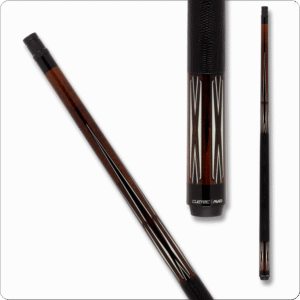
There is a reason so many tournament regulars gravitate toward cues that behave the same way in a humid September casino ballroom as they do in a dry January one. Every variable you remove from your equipment is one less thing to compensate for at the table. That is the whole design philosophy behind the Cuetec Avid line, which pairs a 29-inch AVID low-deflection shaft, built from multiple plies of glass composite bonded to kiln-dried maple, with a 12.75mm Tiger Everest laminated tip and a 3/8 x 14 joint that also fits Cuetec’s Cynergy cues.
The composite-bonded shaft is the part that matters for consistency. Bare maple moves with the weather. A glass-fiber-wrapped maple core resists that movement and shrugs off the dings and dents a cue picks up living in a case that gets thrown in a trunk every weekend. The Cuetec AVID CT325NW at $409 is the wrapless version for players who like bare wood under the grip hand, while the CT326LTC at $449 adds a leather wrap on the same platform. Both use the Tiger Everest medium tip, and both are weight-changeable, so the balance can be tuned to your stroke instead of the other way around.
If you would rather spend closer to $300, the Avid Chroma CTAC1 Bordeaux at $289 gives you the same AVID shaft and Tiger Everest tip on a wrapless metallic-paint butt, and it ships with a joint protector and a case. The Avid Opt-X CT381 Red at $399 sits between them with a leather wrap, traditional points in the forearm, and a Duo Smart bumper that is ready to accept an extension, which matters more than you think on a nine-foot tournament table when the cue ball ends up on the far rail.
Featured Cuetec Products
-
Sale!
-
Cuetec AVID CT326LTC Cue – Wrap
Original price was: $499.00.$449.00Current price is: $449.00. Add to cart -
Sale!

-
Cuetec AVID CT325NW – No Wrap
Original price was: $459.00.$409.00Current price is: $409.00. Add to cart -
Sale!

-
Cuetec AVID Chroma CTAC1 – Bordeaux
Original price was: $319.00.$289.00Current price is: $289.00. Select options -
Sale!

-
Cuetec Avid Opt-X CT381 Red Cue – 12.75mm
Original price was: $439.00.$399.00Current price is: $399.00. Select options
What Morra’s Fifth Place Teaches About Defending
John Morra came into Verona as the January champion and left with a tie for fifth. That is not a bad result by any measure, but it illustrates something every league player who has ever won a session title knows: defending is harder than winning. Everyone in the room is a little more locked in against the champion, and the champion is carrying a set of expectations that did not exist the first time around.
The fix is boring and effective. Play the table, not the title. Morra’s January title and September top-five together still make him one of the most consistent performers on the Joss Tour, and consistency across events is what actually builds a ranking. One hot weekend is a story. Two deep runs in nine months is a career.
Regional Grinders Are the Story of This Event
Kevin Clark’s third-place finish and $4,000 payday came against a bracket stacked with players who compete internationally. Casanzio, a Rochester regular, cashed again. Cayer and Hewitt kept the Quebec contingent in the money. Dupuis, who won a Joss Tour stop in May, found his way to a thirteenth-place tie. The Joss Tour has always been where Northeast regional players get to test themselves against traveling pros with real money on the line, and Classic XLII delivered that in full.
For a player in the Carolinas or anywhere else outside the Northeast, the model still applies. Regional tours are where your game gets measured against people who are better than your league. Enter them. Lose to good players. Take notes on what they do between shots, because that is where the gap usually lives, not in the cut shots.
Looking Ahead to Classic XLIII
Turning Stone Classic XLIII is already on the calendar for January 13 through 16, 2027, again with $25,000 added. Neuhausen goes in as the man to beat on the strength of his Verona record, with Shaw and Morra close behind on pedigree and Wilkie and Clark carrying momentum from September. The field has not been published yet, so the argument over the favorite will run for four months.
Between now and then, the best thing you can do for your own game is decide what your equipment is going to be and then stop thinking about it. Pick a cue, pick a tip, pick a weight, and put your practice hours into speed control and decision-making, the two things that separated the top four in Verona from everyone else. Browse the full range of pool cues at Quarter King Billiards, and if you want a second opinion on weight or shaft pairing before you order, our staff plays the game and is glad to talk it through.

About Corey Bernstein
Corey Bernstein is a competitive pool player, billiards equipment specialist, and co-owner of Quarter King Billiards in Wilmington, North Carolina. With over a decade of experience in the sport, Corey has competed in regional APA and BCA sanctioned tournaments and maintains an intimate knowledge of cue construction, shaft technology, and table mechanics. As a certified dealer for brands including Predator, McDermott, Jacoby, Viking, Lucasi, Meucci, Joss, and Cuetec, Corey personally tests and evaluates every cue that comes through the shop. His hands-on approach to the business means he has racked thousands of hours behind the table — breaking in shafts, comparing tip compounds, and dialing in the nuances that separate a good cue from a great one. When he is not behind the counter or on the table, Corey is researching the latest advances in low-deflection technology, carbon fiber shaft construction, and cue ball physics. His articles on Quarter King Billiards combine real-world playing experience with deep product knowledge to help players at every level find the right equipment for their game.