 844 408 3056


 Hot Deal

Thirty-seven players paid into the One Pocket division of the 53rd Texas Open at Skinny Bob’s Billiards in Round Rock, Texas, and the field read like a who’s who of the discipline: Fedor Gorst, Shane Van Boening, Tony Chohan, Alex Pagulayan, Jeffrey De Luna, Sergio Rivas. When the $20,000-added event wrapped up on Friday, Sept. 4, the man holding the $17,975 first prize was Brandon Shuff, a Frederick, Maryland player who has been cashing in regional and professional events for 23 years without ever quite getting the one pocket breakthrough his peers kept predicting.
He got it in Texas, and the way he got it is worth studying if you play one pocket, or if you simply want to understand what separates a grinder from a champion in a game where one loose shot can hand your opponent a five-ball run.
How the bracket unfolded
Shuff’s first three matches did not produce a single lost rack. He shut out Jonathan Demet, Pete Bowman and Marc Vidal Claramunt in succession, then met Gorst in a winners’ side quarterfinal that went double hill before Shuff advanced. A 4-1 win over Sergio Rivas in the winners’ semifinal put him in the hot seat match with only four racks scored against him all week.
De Luna arrived at that hot seat match on a different sort of run. He had survived Chip Compton double hill in the opening round, blanked Christopher Tevez, beaten Pagulayan 4-2 and then shut out Van Boening in the other winners’ semifinal. In the hot seat match it was De Luna who looked untouchable, giving up a single rack to Shuff and sending him to the one loss side of the bracket.
That is where the week turned. Tony Chohan had been carving through the loss side, surrendering just three racks in four matches before beating Rivas double hill and then Van Boening double hill in the quarterfinal. Shuff met him in the semifinal on Friday morning and did not give him a rack in a match that still took two and a half hours. In the true double elimination final, Shuff took the first set from De Luna 4-1 to square the match, then won a double-hill second set to claim the title. According to AZBilliards, his aggregate game score across nine matches was 31-11, roughly 73 percent of the racks played, against the strongest one pocket field of the year.
De Luna took home $12,400 for second, Chohan $7,900 for third and Van Boening $5,400 for fourth. Gorst and Rivas split fifth and sixth at $3,900 each.
Habit one: a shutout is built from refusals, not fireworks
Three consecutive shutouts to open a one pocket event does not happen because a player is firing in banks. It happens because he refuses to give his opponent a shot. One pocket is scored in balls, but it is really played in cue ball positions, and Shuff’s early matches were a clinic in leaving the cue ball where the next shot was either impossible or a sell-out. If you are new to the discipline, our guide on how to play one pocket covers the rules and the opening break. The lesson from Round Rock is simpler: the player who gives up the fewest chances wins, and the player who wins most often is the one who is comfortable shooting a nothing shot ten times in a row.
That takes a specific kind of speed control. Most of one pocket is played at lag speed, where the difference between a perfect safety and a hanging ball is a few inches of roll. That skill is developed, not bought, but the cue you develop it with matters more than in any other game. We will come back to that.
Habit two: losing the hot seat is information, not a verdict
Giving up four racks in four matches and then losing 4-1 to De Luna would rattle most players. Shuff’s response was to go straight into a semifinal against Chohan, one of the best one pocket players alive, and blank him. There is no mystery ingredient here. Shuff told AZBilliards, “I’m a persevering type of person,” and his career backs it up: a 2012 Mosconi Cup appearance alongside Van Boening, Johnny Archer, Mike Dechaine and Dennis Hatch, a runner-up finish to Van Boening in one pocket at the 2026 Midwest Billiards and Cue Expo, a fourth place in the Derby City Classic one pocket division a year ago.
The takeaway for league and tournament players is to treat a lost hot seat match as a scouting report. De Luna had shown Shuff exactly how he wanted to play the table. In the final, Shuff was the one dictating tempo.
Habit three: outlast the marathon
The Van Boening versus Gorst loss side match ran just under two hours on the DigitalPool time stamps. The Shuff versus Chohan semifinal took two and a half hours for four racks. The first set of the final ran nearly four hours. One pocket at this level is a stamina event dressed up as a pool tournament, and the players who win it are the ones whose fundamentals do not degrade in hour four. Stance, grip pressure and stroke tempo all drift when you are tired. If yours drift, you will start missing the soft shots, and soft shots are the whole game.
Habit four: play a cue you can feel at slow speed
Here is where equipment enters the conversation in a way that is not marketing. A break cue is judged by how it performs at maximum effort. A one pocket cue is judged by how much information it sends back to your hand when you are rolling the cue ball a diamond and a half. Players in this discipline tend to gravitate toward maple shafts, medium tips and a slightly softer, more communicative hit, because the feedback lets them calibrate speed rack after rack.
That profile describes Meucci almost exactly. Bob Meucci founded Meucci Originals in 1975 and built the brand on shafts engineered to reduce cue ball deflection while keeping a lively, responsive feel. The current expression of that is The Pro Shaft, a 29 inch solid maple shaft with Meucci’s Black Dot technology, a 12.5mm Ultra Skin medium tip and a 5/16 x 18 joint. Every playing cue in the Meucci lineup we carry ships with it, and every one is weight adjustable through Meucci’s bolt system, which matters when you are tuning balance for touch rather than power.
The Meucci MEJSS Jayson Shaw cue is the entry point to the line at $550 and carries the same Pro Shaft as cues costing twice as much, wrapped in smoke stained birdseye maple with a black and white Irish linen wrap. Jayson Shaw plays Meucci on the World Nineball Tour, and this is the design that carries his name at the accessible end of the range. Step up to the Meucci MEF01 at $710 and you get grey stained birdseye maple with cocobolo points outlined in black and white veneers, plus nickel silver rings and synthetic mother-of-pearl inlays in the collar and butt sleeve.
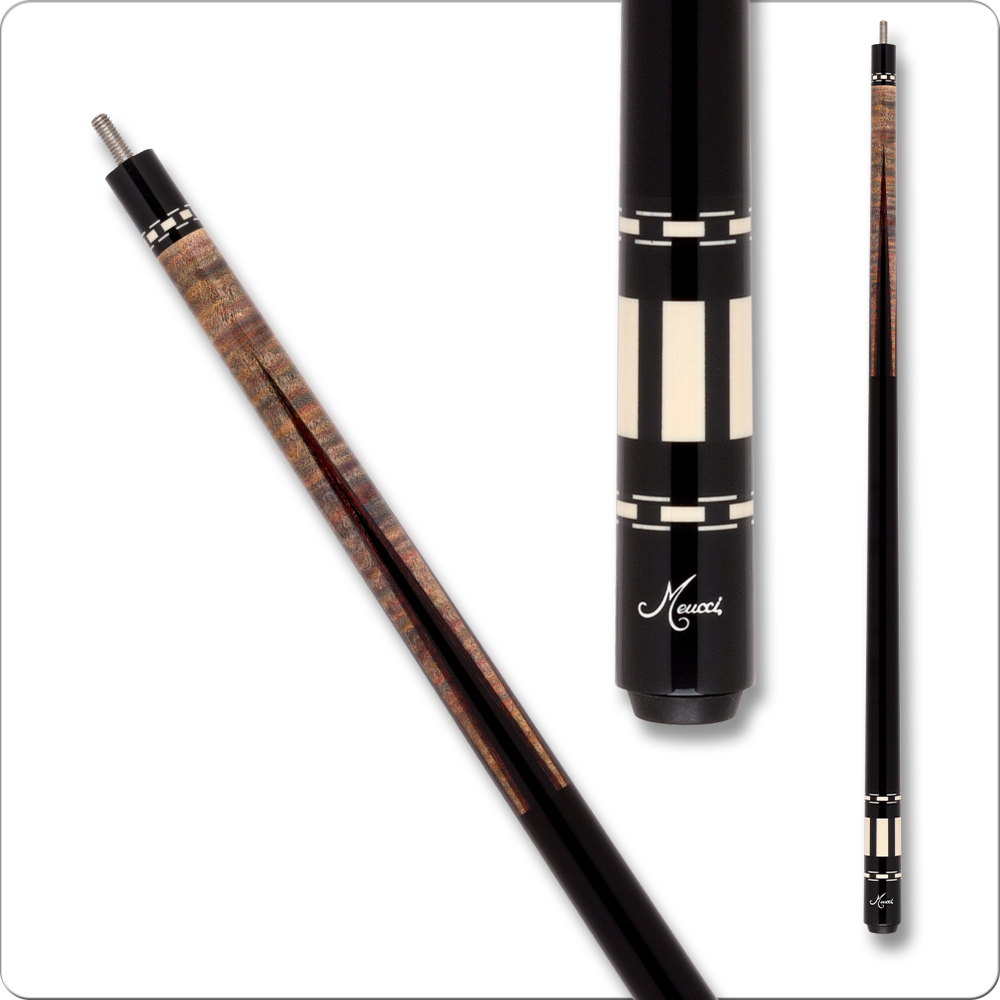
The Meucci MEHOF01 Hall of Fame cue at $840 is the one pictured above: four ebony colored points outlined in blue, green and brown veneers, six long ivory colored windows in the butt sleeve and a black Irish linen wrap. At the top of our featured group, the Meucci MEHP03 High Pro at $900 pairs lightly stained birdseye maple with four ebony colored points inset with white and blue acrylic diamonds and blue mirror collars. If you prefer a more traditional look, the Meucci MEP02 Power Piston and the Meucci MEJS01 sit in between at $735 and $760.
All of these are made in the USA, all use the same 5/16 x 18 pin so shafts interchange across the line, and all carry Meucci’s limited warranty. Weight options run from 18 to 21 ounces on most models. For a touch game like one pocket, many players land at 19 or 19.5 ounces and let the balance, not the mass, do the work.
Featured Meucci Products
-
-
-

-
-
-
What to do with this before your next one pocket set
Start with the shutout mindset. For one practice session, play the ghost in one pocket and score yourself only on whether you left a shot. Not whether you made a ball, whether you left one. You will find out quickly how many of your habitual shots are secretly sell-outs.
Second, spend ten minutes on lag speed before every session. Roll the cue ball from the head string to stop within a ball’s width of the foot rail, ten times. Then aim to stop it a ball’s width short of the side pocket. This is the skill that produced 31-11 in Texas, and it is the skill your tip choice and shaft either help or hinder.
Third, be honest about your cue. If it feels dead at soft speed, if you cannot tell the difference between a stop shot and a slight follow in your hand, you are playing one pocket with a hammer. A responsive maple shaft with a medium tip is the classic answer, and the Meucci lineup is the most direct route to it that we stock. Browse the full range of Meucci pool cues, or start wider in our pool cues collection if you are still comparing brands.
As for Shuff, he was two matches into the Texas Open 9-Ball division when he gave his interview, and he said he hoped to be having another conversation when it was over. Whatever happens in the 9-ball, the one pocket title stands as the breakthrough his career had been building toward, and it was won the old fashioned way: by refusing to give the other guy a shot.

About Corey Bernstein
Corey Bernstein is a competitive pool player, billiards equipment specialist, and co-owner of Quarter King Billiards in Wilmington, North Carolina. With over a decade of experience in the sport, Corey has competed in regional APA and BCA sanctioned tournaments and maintains an intimate knowledge of cue construction, shaft technology, and table mechanics. As a certified dealer for brands including Predator, McDermott, Jacoby, Viking, Lucasi, Meucci, Joss, and Cuetec, Corey personally tests and evaluates every cue that comes through the shop. His hands-on approach to the business means he has racked thousands of hours behind the table — breaking in shafts, comparing tip compounds, and dialing in the nuances that separate a good cue from a great one. When he is not behind the counter or on the table, Corey is researching the latest advances in low-deflection technology, carbon fiber shaft construction, and cue ball physics. His articles on Quarter King Billiards combine real-world playing experience with deep product knowledge to help players at every level find the right equipment for their game.