 844 408 3056

 Hot Deal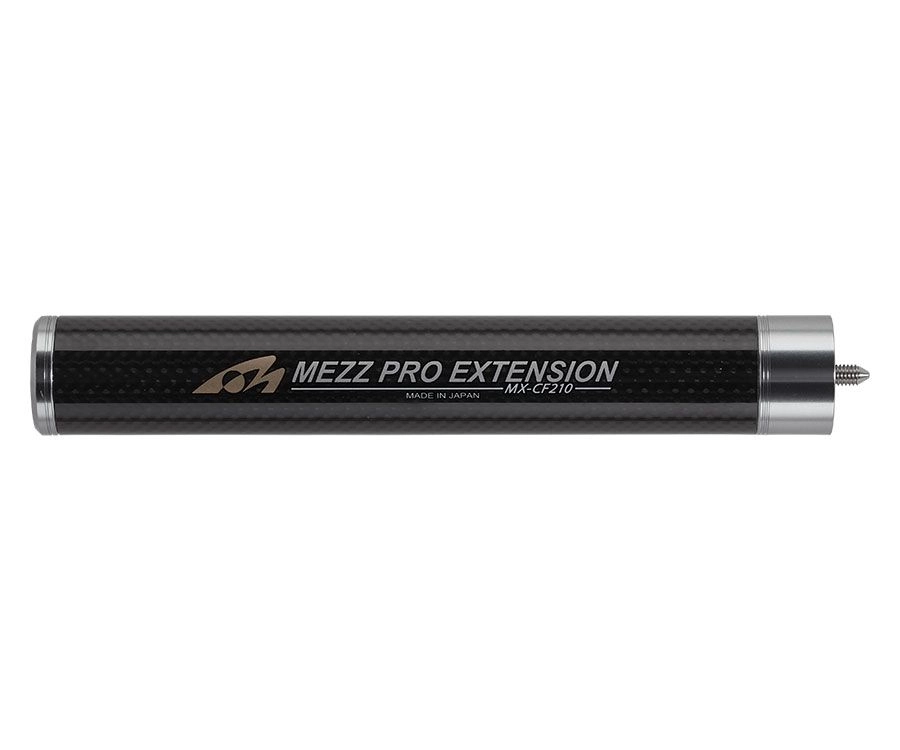
You have been running out on the bar box all summer. Then you enter a tournament on nine footers, and suddenly you are missing shots you have made a thousand times. Nothing is wrong with your stroke. The table changed the problem, and most players never sit down and work out exactly how.
A seven foot bar box and a nine foot table are not the same game played at different sizes. The distances, the pocket geometry, the cloth speed, and even the way you have to stand all shift. Here is what actually changes, in the order it will hurt you.
Distance punishes aim errors twice
Aim error is angular. If your cue tip is off by a fixed amount at contact, the object ball leaves the correct line by a fixed angle, and the miss grows with distance. Move from a four foot shot to an eight foot shot and you roughly double the amount your object ball drifts off line before it reaches the pocket.
This is why bar box players describe nine footers as feeling unfair. They are not shooting worse. They are being shown the same error at higher magnification. The fix is not to aim harder. The fix is to tighten the delivery, because a straighter stroke shrinks the error at its source.
The practical drill
Set an object ball on the foot spot and the cue ball on the head spot, straight in to the corner. Shoot it ten times with a stop shot. On a nine footer this is a genuinely difficult shot, and it exposes any sideways drift in your stroke immediately. If the cue ball squirts left or right after contact, your tip is not arriving where you think it is. Do this before every session on a big table and you will spend the rest of the night trusting your aim.
Pockets are usually tighter, and cut shots get brutal
Most tournament nine footers run tighter pockets than the bar box in your local tavern, often four and a half inches or less against five inches or wider. That difference does not sound like much until you start cutting balls thin. A tight pocket eats a thin cut that a bar box pocket would have accepted on a rattle.
The adjustment is positional, not mechanical. On a tight table you want to arrive at shots closer to straight. That means your position play has to become more precise, and it means taking the two rail route that leaves you a manageable angle instead of the one rail route that leaves you thin on the same ball.
Cloth speed and the death of the lazy roll
Tournament tables typically wear worsted cloth like Simonis, which runs noticeably faster than the napped cloth on many coin operated tables. Faster cloth means the cue ball keeps traveling, so the speed that used to park you perfectly now sends you two diamonds long.
Faster cloth also holds spin longer. English that faded before the third rail on a bar box will still be working when the cue ball arrives. That is an advantage once you calibrate to it, and a disaster before you do. Give yourself twenty minutes of pure speed control practice before you compete on unfamiliar cloth. Shoot the cue ball up and down the table with follow and with draw, and just watch how far it goes.
You cannot reach, and that is a real problem
This is the one nobody warns bar box players about. On a seven foot table you can reach almost everything with a normal stance. On a nine footer, a cue ball frozen near the head rail with the object ball down at the foot rail puts you on your tiptoes with your chest on the rail and your bridge hand somewhere you have never bridged from.
Stretching wrecks stroke mechanics. Your elbow drifts outside the shot line, your grip hand tightens to stabilize your body, and the cue delivers across the ball. That is the actual source of most long table misses, not aim.
There are three legitimate answers, and you should own all three.
Use the mechanical bridge without shame
The bridge is a legal piece of equipment and every professional uses it. The technique is different enough that it needs practice: keep your chin over the cue, deliver with the forearm rather than the wrist, and avoid squeezing the butt. Ten minutes a week is enough to make it feel normal.
Use an extension
A rear extension screws into the bumper end of your cue and adds three to twelve inches of usable length. It lets you keep your own bridge, your own stance, and your own stroke on shots that would otherwise force the bridge. Forward extensions do something slightly different, shifting balance toward the front for players who want more weight ahead of the grip hand.
Play position so you never need either
The best long distance solution is not arriving at long distance shots. On a big table, pattern play matters more than it does on a bar box, because the penalty for landing on the wrong side of the table is a full stretch instead of a small walk.
Featured Cue Extensions
These are the extensions worth owning if you split time between table sizes. Match the thread type to your cue when you order, and check whether your cue accepts a rear extension at the bumper.
-
-
-
Sale!
-
Balabushka EXTRGB Rear Extension
Original price was: $205.00.$184.50Current price is: $184.50. Add to cart -
-
-
-
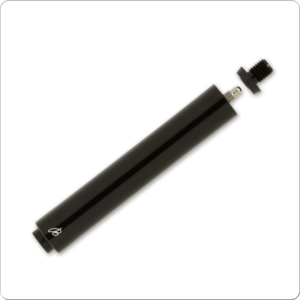
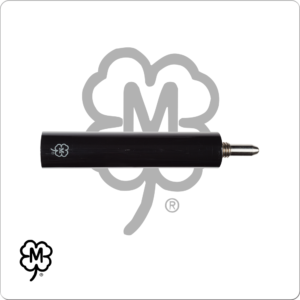
The Mezz EXTRZZ Rear Extension at $190 is built for Mezz butts and adds usable length without making the cue feel tail heavy. The Balabushka EXTRGB Rear Extension at $184.50 does the same job for Balabushka cues.
If you want the most flexible option, the Cuetec EXTRCA DUO Rear Extension at $135 is designed to work in more than one configuration. And for players who would rather add weight forward than length behind, the McDermott EXTFMCD Forward Extension at $82 is the least expensive way to change how a cue balances.
Rail height, stance, and the thing nobody mentions
Rails on a nine foot table sit at the same height as rails on a seven footer, but you are reaching across more of the table to get to them. That means more of your shots are taken with your torso partly supported by the rail, which changes where your weight sits and how freely your shoulder can move.
Pay attention to your back foot. When you stretch, most players let the back foot slide or roll onto its edge, and the moment that happens your body is no longer stable enough to deliver a straight cue. If you have to stretch, plant deliberately before you get down. Set the feet, then build the bridge, then get your eyes over the line. Reversing that order is how a routine long shot becomes a scratch in the side.
The other quiet difference is the shot clock in your head. Big table matches simply take longer. Racks that finish in four minutes on a bar box take seven or eight on nine feet, which means a race to seven is a genuinely different endurance problem. Players who fade in the second hour of a bar box session will fade in the first hour on a big table.
A four week transition plan
If you have a big table event coming, do not just show up. Week one, book an hour a week on a nine footer and shoot nothing but long straight stop shots. Week two, add speed control lanes: cue ball up and down the table to a target zone, five different speeds. Week three, play the ghost and pay attention to every shot where you had to stretch, then work out what position error put you there. Week four, play actual sets against someone better than you.
Four hours of that will do more for your big table game than four months of bar box racks. The skills transfer back too. Players who learn to control the cue ball on nine feet of fast cloth find the seven footer becomes almost easy.
Round out your setup with the rest of our cue extension selection, look at bridgeheads if you would rather practice the bridge properly, or browse the full pool cues catalog if the big table has you thinking about an upgrade.

About Corey Bernstein
Corey Bernstein is a competitive pool player, billiards equipment specialist, and co-owner of Quarter King Billiards in Wilmington, North Carolina. With over a decade of experience in the sport, Corey has competed in regional APA and BCA sanctioned tournaments and maintains an intimate knowledge of cue construction, shaft technology, and table mechanics. As a certified dealer for brands including Predator, McDermott, Jacoby, Viking, Lucasi, Meucci, Joss, and Cuetec, Corey personally tests and evaluates every cue that comes through the shop. His hands-on approach to the business means he has racked thousands of hours behind the table — breaking in shafts, comparing tip compounds, and dialing in the nuances that separate a good cue from a great one. When he is not behind the counter or on the table, Corey is researching the latest advances in low-deflection technology, carbon fiber shaft construction, and cue ball physics. His articles on Quarter King Billiards combine real-world playing experience with deep product knowledge to help players at every level find the right equipment for their game.