 844 408 3056

 Hot Deal
Somewhere around the intermediate level, every pool player hits the same wall. You can run four or five balls, you know your patterns, and you still lose to people who make fewer balls than you do. The difference is almost always defense. The player who wins those matches is the one who recognizes, three shots early, that this rack cannot be run, and starts playing chess while you are still playing darts. Watch any professional match, including the safety battles that shaped the Arizona Open final this weekend, and count how many innings end with a lock-up safety instead of a run-out attempt. Defense is not the absence of offense. It is offense with a one-rack delay.
The Decision Comes Before the Shot
Amateurs play safeties when they are already in trouble. Strong players decide between offense and defense on nearly every visit, and they make the call with brutal honesty. Here is the practical test. Look at the table and ask three questions. Can I pocket this ball at better than eighty percent? Does making it leave me a real shot on the next ball? If I miss, what does my opponent get? If the answers are no, no, and everything, the safety is not the cowardly choice. It is the only choice that respects math.
The most common leak in league play is the hero cut. Down two balls, hooked on your lowest ball or facing a thin cut down the rail, you fire at a shot you make three times out of ten because playing safe feels like surrender. Over a season that decision costs more matches than any mechanical flaw in your stroke. The fix is a rule, not a feeling: when the make percentage drops below the odds that your safety leaves your opponent stuck, defense wins the calculation, every single time.
Three Safeties That Cover Ninety Percent of Situations
The Distance Safety
The simplest weapon in the kit. Send the object ball to one end of the table and the cue ball to the other. No blocker needed, just distance. A long hit with a thin cut is hard even for good shooters, and most opponents will return a weak safety or leave you an opening. Speed control matters more than precision here. Practice rolling the cue ball the full length of the table so it dies within a diamond of the rail, because a cue ball that drifts one diamond too far turns a lock into a road map.
The Blocker Safety
Park the cue ball behind an obstructing ball so your opponent has no direct path to their target. This is the safety that wins games outright, because a full hook forces a kick, and kicks produce fouls and sell-outs. The skill is in the last six inches of cue ball travel. You are not shooting at a pocket, you are shooting at a parking space the size of a coaster, which is why the speed drills below matter more than any aiming system.
The Rail Freeze
Glue the cue ball to a cushion. Your opponent now has to elevate the butt, bridge awkwardly, and strike the top half of a ball they can barely address. Even without a blocker, a frozen cue ball cuts a good shooter down to average. Combine it with distance and you have handed them the hardest routine shot in pool.
Two-Way Shots: The Professional Cheat Code
The best defensive players rarely choose between offense and defense at all. A two-way shot is an offensive attempt shaped so that a miss still leaves your opponent nothing. Shoot the ball down the rail at pocket speed, and if it does not drop it sits in the jaws while the cue ball drifts behind traffic. You get the make or you get the safety, and your opponent gets to pick which poison. Building this habit starts with pocket speed, which means hitting shots just hard enough to reach the pocket and no harder. Blasting every ball at warp speed does not just look nervous. It surrenders the two-way option on every shot you take.
Why Your Cue Matters More on Safeties Than on Run-Outs
This surprises people. On an open shot, a mediocre cue and a great cue pocket the same ball. On a safety, you are controlling two balls at once with fractional speed differences and paper-thin contacts, and equipment consistency starts to show. Low deflection shafts keep thin hits predictable when you apply sidespin to hold or release the cue ball. A stable, well-balanced butt keeps your delivery identical at the soft speeds where cheap cues feel like swinging a pool noodle.
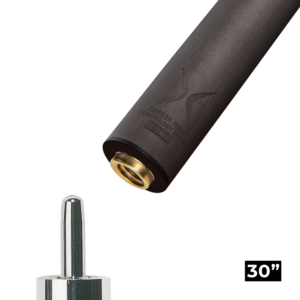
This is the territory where the Pure X line earns its reputation. These cues ship with the HXT low deflection shaft technology that made the brand a favorite of players who want performance without a four-figure price. The Pure X matte silver with MZ grip plays far above its price point, the grey stained birdseye maple model adds a cocobolo wrapless handle for players who like a naked grip, and if you want to upgrade a cue you already love, the Pure X 30 inch carbon fiber shaft brings carbon predictability to almost any butt for well under four hundred dollars.
Featured Pure X Cues and Shafts
-
-
-

-
-

-
One warning before the drills: defense has its own failure mode. Some players discover safeties and fall in love, ducking on shots they make nine times out of ten and handing easy innings to opponents who just keep shooting. The eighty percent rule cuts both ways. If the shot is there, take it. Safety play is a tool for the racks the table refuses to give you, not a personality. The goal is a game where your opponent never gets a free swing, whether that swing comes from your miss or from your unnecessary duck.
Drills That Build a Defensive Game
The Coaster Drill
Place a coaster or a chalk cube anywhere on the table. From ball in hand, shoot the cue ball off an object ball and try to leave it dead on the target. Ten attempts, score your hits, move the target. This is pure cue ball speed training, and it transfers directly to blocker safeties. When you can park the cue ball on a coaster from six feet, hiding it behind a ball feels easy.
The Safety Ghost
Everyone knows the run-out ghost. Flip it. Throw nine balls on the table, take ball in hand, and play the best safety you can find. Then walk around and try to beat your own safety. If you can escape it, your safety was not good enough. This trains both halves of the exchange, and it is weirdly addictive once you start grading yourself honestly.
The Kick Save
Defense includes getting out of jail. Set up hooks and practice one-rail kicks to a legal hit. You do not need to pocket balls kicking, you need to avoid handing over ball in hand. Players who kick at eighty percent legal contact remove most of the value of their opponent’s safety game, which changes the whole strategic conversation.
Defense Wins Sets, Not Style Points
Nobody films their safeties for social media. But ask anyone who has climbed from a C player to an A player what actually changed, and the answer is always the same: shot selection and defense, not a secret aiming system. Start choosing the safety when the math says safety. Learn three of them well. Build the speed control that makes them stick, with equipment that behaves the same way at soft speed every single time. Our full pool cue collection covers every budget, and the Pure X lineup in particular gives you tour-level shaft technology at a league-night price. Your opponents will not thank you, and that is the point.

About Corey Bernstein
Corey Bernstein is a competitive pool player, billiards equipment specialist, and co-owner of Quarter King Billiards in Wilmington, North Carolina. With over a decade of experience in the sport, Corey has competed in regional APA and BCA sanctioned tournaments and maintains an intimate knowledge of cue construction, shaft technology, and table mechanics. As a certified dealer for brands including Predator, McDermott, Jacoby, Viking, Lucasi, Meucci, Joss, and Cuetec, Corey personally tests and evaluates every cue that comes through the shop. His hands-on approach to the business means he has racked thousands of hours behind the table — breaking in shafts, comparing tip compounds, and dialing in the nuances that separate a good cue from a great one. When he is not behind the counter or on the table, Corey is researching the latest advances in low-deflection technology, carbon fiber shaft construction, and cue ball physics. His articles on Quarter King Billiards combine real-world playing experience with deep product knowledge to help players at every level find the right equipment for their game.