 844 408 3056


 Hot Deal

Wojciech Szewczyk closed out the 2026 WPA Men’s 10-Ball World Championship in Ho Chi Minh City on September 26, taking his second world title in the discipline after first winning it in 2022. The Polish pro had to fight through a 96-player international field spread across a double-elimination opening phase and a single-elimination knockout bracket, with every set in the final rounds racing to four racks and a shootout waiting in reserve if a set ever tied at three games apiece.
The event carried a $300,000 total prize fund, with $80,000 going to the champion and $40,000 to the runner-up. Semifinalists collected $20,000 each, quarterfinalists $10,000, and players eliminated in the last 16 and last 32 still walked away with $5,000 and $2,500 respectively, down to $1,250 for the losers’ qualification round. That kind of payout structure is part of why the WPA World 10-Ball Championship has become one of the marquee stops on the international calendar, alongside the Mosconi Cup and the US Open.
Szewczyk’s run to the title came in a week that had already produced plenty of storylines in Ho Chi Minh City. Earlier in the tournament, established names including Carlo Biado, Duong Quoc Hoang, and Konrad Maciol were knocked out before reaching the final 32, a reminder of how deep and unpredictable the modern 10-ball field has become. On the women’s side of the same Predator Pro Billiard Series swing, Pia Filler took the Poison Saigon Women’s 9-Ball Open at Phu Tho Indoor Stadium. Between the two results, Vietnam turned into one of the busiest weeks of the year for competitive pool.
The format itself is worth understanding if you are new to following international 10-ball. Early rounds ran as best of three sets, with each set a race to four racks, which keeps the door open for a player to drop a set and still survive the match. Once the field narrowed into the single-elimination knockout, the format stiffened to best of five sets, still a race to four racks each, which puts a real premium on being able to close out a set instead of riding momentum from a hot start. A shootout only comes into play if a set reaches three games apiece, and it is designed to end things quickly rather than let a match drag deep into overtime after overtime.
What a World Championship Week Actually Demands From a Player’s Gear
A 96-player bracket that stretches across a double-elimination stage and then a single-elimination knockout is not a one-and-done afternoon. Depending on the draw, a player can be at the table for a dozen matches or more before the trophy is decided, often carrying two or three cues, a jump cue, a break cue, and a case full of tips, chalk, and joint protectors from one session to the next. Between matches those cues have to go somewhere, and “somewhere” in a crowded tournament room usually means a rack, a rail, or a dedicated cue holder rather than a case that has to be repacked every hour.
Club players run into the same logistics problem on a smaller scale. A Tuesday night league match, a weekend tournament at the local room, or just a practice session where you are rotating between a playing cue and a break cue all create the same basic need: a stable, upright place to set a cue down where it will not roll off a table, get stepped on, or warp against a wall. That is a small detail, but it is the kind of detail that separates a room that treats its equipment carefully from one that does not, and it matters just as much for a $200 cue as it does for a $2,000 one.
Featured Cue Holders From Quarter King Billiards
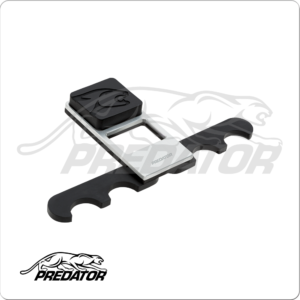
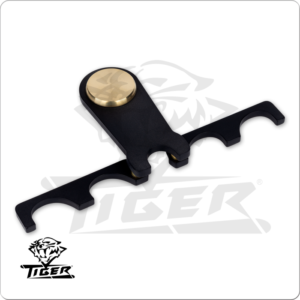
We carry a small lineup of cue holders built for exactly this job, ranging from a budget four-cue stand to a five-cue floor unit with a cleaner footprint for a home room or a pro shop counter.
-
-
-
-
-

-
-

-
The Tiger Paw QHTP5 holds five cues and is made in the US, which makes it a solid pick for a room that rotates through a playing cue, a break cue, and a jump cue without cluttering a table rail. The Tiger QHTP3 Paw is the same basic design scaled down to three cues, a good fit for a home setup where floor space is tighter. The Predator QHPRE holds four cues at a mid-range price point, and the Porper QHPOR4 is the value option in the lineup, still built in the US and still a real upgrade over leaning a cue against a wall where the tip or the joint can take damage.
Choosing between them usually comes down to two questions: how many cues you actually need to store at once, and where the holder is going to live. A pro shop counter or a home game room with a dedicated table can justify the larger Tiger Paw QHTP5, since a five-cue capacity covers a playing cue, a break cue, a jump cue, and still leaves room for a house cue or two without crowding the base. A smaller apartment setup or a case that already travels with its own storage is usually better served by the three-cue QHTP3 or the four-cue Predator and Porper options, which take up less floor space while still keeping cues upright and off the felt or the floor.
It is also worth thinking about how a cue holder changes the way you treat your equipment day to day. A cue that gets set down on a stand between shots, instead of balanced against a rail or a wall, is far less likely to pick up a nick on the joint or a warp from resting at an angle for an hour. That is a small habit, but it adds up over a season of league nights, and it is exactly the kind of unglamorous discipline that separates players who keep their gear in tournament-ready shape from players who are surprised when a shaft starts rolling unevenly on the felt.
Why This Result Matters Beyond the Trophy
Szewczyk’s second world 10-ball title puts him in a small group of players who have won the event more than once, and it reinforces something that shows up in almost every deep tournament run: consistency across a long week beats a single hot session. The players who make it from a field of 96 down to the final table are not just the ones who can win a race to four once. They are the ones whose equipment, preparation, and routine hold up match after match, day after day, without anything breaking down.
That is a lesson that scales down just as well to a weekly league night as it does to a $300,000 world championship. Keeping your cues organized, protected, and ready between matches is not a glamorous part of the game, but it is one of the few things every player, from a first-time league shooter to a world champion, actually controls. A cue that sits safely on a stand between racks instead of leaning against a table rail is one less thing that can go wrong on a night when everything else is already hard enough.
Looking Ahead on the Calendar
With the WPA World 10-Ball Championship and the Poison Saigon Women’s 9-Ball Open both wrapped up, the international schedule keeps moving toward the Reyes Cup in Manila and the Mosconi Cup later in the fall. Club and league players who want to sharpen their own 10-ball game in the meantime can find the full range of pool cues we carry, along with the practical accessories, like cue holders, that keep a session running smoothly instead of getting bogged down in equipment shuffling between shots.
Whether you are chasing a league title or just trying to keep your home table organized, a $65 to $80 accessory that protects a cue worth many times that is one of the easier upgrades to justify. Check out the full Predator QHPRE and Porper QHPOR4 listings for exact dimensions before you buy, and pair either one with the full accessories catalog at Quarter King Billiards.

About Corey Bernstein
Corey Bernstein is a competitive pool player, billiards equipment specialist, and co-owner of Quarter King Billiards in Wilmington, North Carolina. With over a decade of experience in the sport, Corey has competed in regional APA and BCA sanctioned tournaments and maintains an intimate knowledge of cue construction, shaft technology, and table mechanics. As a certified dealer for brands including Predator, McDermott, Jacoby, Viking, Lucasi, Meucci, Joss, and Cuetec, Corey personally tests and evaluates every cue that comes through the shop. His hands-on approach to the business means he has racked thousands of hours behind the table — breaking in shafts, comparing tip compounds, and dialing in the nuances that separate a good cue from a great one. When he is not behind the counter or on the table, Corey is researching the latest advances in low-deflection technology, carbon fiber shaft construction, and cue ball physics. His articles on Quarter King Billiards combine real-world playing experience with deep product knowledge to help players at every level find the right equipment for their game.