 844 408 3056

 Hot Deal
Shane Van Boening walked back into the Caribe Royale Resort in Orlando carrying a grudge against a room. One year earlier he had reached the Florida Open final and lost it. On August 9 he returned to the same arena, beat Alexander Kazakis 13-5, and left with the trophy and a $40,000 check. The scoreline looks lopsided. The pool inside it was not, and the way Van Boening pulled away from a dangerous opponent is worth studying if you play league nights, tournaments, or gambling sets on a bar box.
The second edition of the Florida Open Pool Championship ran August 4 through 9 as part of the World Nineball Tour’s August USA swing. Van Boening arrived as a five-time US Open champion who had been hearing about the one that got away. He left as the man sitting on top of the Team USA rankings with the Mosconi Cup in his sights.
How the Final Actually Played Out
Van Boening opened by taking the first two racks, which is the least surprising thing about the match. Kazakis answered in the third. Then the pattern that decided the whole final showed up for the first time: Kazakis missed a safety in the fourth rack, and Van Boening converted the opening into a 3-1 lead.
That is the entire final in one sentence. Kazakis was not outshot. He was out-punished. Every time the Greek left a table that was even slightly playable, the American took the rack. Every time Van Boening left something, Kazakis needed a spectacular ball to make him pay, and spectacular balls do not fall often enough to win a race to 13.
Kazakis did fight. In the eighth rack Van Boening missed the 3-ball and handed the table over. Kazakis kept the rack alive with a bank shot, cleared, and cut the deficit to 5-3. That was the closest the match ever felt.
The Shot That Broke the Match Open
At 6-3, Kazakis played a safety that should have bought him a rack. Van Boening jumped it, escaped clean, and ran out. If you want a single frame to explain why the score ended 13-5, that is the one. A safety that works against most opponents is only a stall against a player whose jump game is a real weapon rather than a hopeful swing.
At 8-3 Kazakis got another chance and missed a 9-ball. Van Boening moved to 9-3. Kazakis snapped one off, then dried up on the following break, and control went straight back across the table. Van Boening ran to 11-4. The last real drama came in a long safety exchange where Kazakis fired a bank on the 7-ball that caught the edge of the pocket and refused to drop. Van Boening got to the hill and closed the match the way he wanted to close it, with a break-and-run.
Earlier the same day he had handled Eklent Kaçi 11-6 in the semifinal. Across the week he beat four former world champions. That is not a bracket that opens up. That is a bracket you have to hack your way through.
The Equipment Story Behind the American Hammer
Van Boening has played Cuetec since 2009, and that relationship is unusually specific for a production cue deal. The Cynergy carbon composite shaft was developed with his direct input, and the SVB signature cues are built around the way he actually stands and strokes rather than around a marketing sketch. When a player with that much equipment influence wins with a jump escape and a closing break-and-run, the gear is part of the story.

The practical version for the rest of us is simpler than it sounds. A low-deflection carbon shaft does not make you a shotmaker. What it does is shrink the correction you have to apply when you use side spin, which means your aim stays closer to honest when the pressure rises. That is exactly the benefit you want in rack nine of a hill-hill set, when your stroke is quick and your judgment is tired.
The Signature Tier
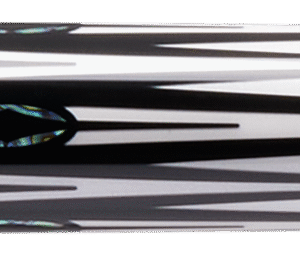
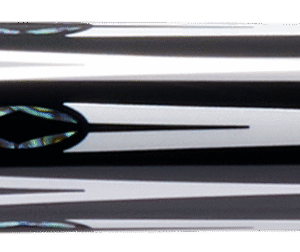
The Cuetec SVB Black Gen 2 and the Cuetec SVB White Gen 2 both sit at $949 and carry the Cynergy shaft as delivered. This is the tier where you stop buying a cue and start buying a specification. If you already break with a dedicated break cue, already keep a chalk you trust, and already know your preferred tip hardness, this is a purchase that will not need revisiting.
The Tier Most League Players Should Actually Buy
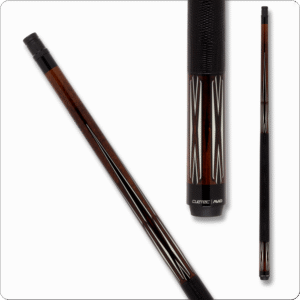
If $949 is more cue than your current game demands, the AVID line is where Cuetec puts real technology into a price a Tuesday night player can justify. The AVID CT326LTC with wrap runs $449, and the no-wrap versions of the same platform come in at $409. You are giving up the signature build and some of the cosmetic work. You are not giving up the fundamental idea, which is a shaft that behaves predictably when you move away from center ball.
Break equipment matters here too. Van Boening’s dry-break punishment of Kazakis cuts both ways: a dry break in a race to 13 is a free rack for your opponent. The AVID CT338NW Surge break cue at $389 exists so you are not hammering racks with the same tip you use to draw the length of the table. If you want the full carbon story on the playing end, the Cynergy CT111NW Truewood at $1,019 splits the difference between signature pricing and AVID value.
Featured Cuetec Products
-
Sale!
-
Cuetec AVID CT326LTC Cue – Wrap
Original price was: $499.00.$449.00Current price is: $449.00. Add to cart -
Sale!
-
Cuetec SVB Black Gen 2
Original price was: $1,049.00.$949.00Current price is: $949.00. Select options This product has multiple variants. The options may be chosen on the product page -
Sale!
-
Cuetec SVB White Gen 2
Original price was: $1,049.00.$949.00Current price is: $949.00. Select options This product has multiple variants. The options may be chosen on the product page -
Sale!

-
Cuetec AVID CT338NW Surge Break Cue
Original price was: $429.00.$389.00Current price is: $389.00. Select options
Three Things League Players Can Steal From This Final
1. Punish the Half-Safety
Kazakis lost the fourth rack because his safety was almost good. Almost good is the most expensive shot in pool. When you play a safety, decide in advance whether you are hiding the cue ball or just moving it, and if you are only moving it, expect to get the table back and plan for that. The flip side is the offensive habit Van Boening showed all match: when your opponent leaves you a thin shot with a route, take it and run out rather than trading another safety and hoping.
2. Own One Escape Shot
The jump at 6-3 was not luck. It was a shot Van Boening has hit ten thousand times, which is why he was willing to hit it with a match on the line. Most league players own zero reliable escapes. Pick one, either a jump or a two-rail kick, and drill it until you would fire it in a final rather than rolling out and praying. Our guide on break and jump equipment covers what actually makes those shots repeatable.
3. Finish With the Break
Van Boening closed the match with a break-and-run, and that is not a coincidence in a race that long. The players who win majors treat the break as a scoring shot with a target, not as a swing. Consistent cue ball position after the break is a skill you can practice on a slow Tuesday for free.
What Comes Next
The tour does not slow down. The World Nineball Tour heads straight to Yuma, Arizona for the inaugural Arizona Open Pool Championship at the Quechan Casino Resort, August 13 through 16. It is a 128-player single-elimination field playing for a $125,000 prize fund, and single elimination means one bad rack ends a week. After that the calendar points at the US Open Pool Championship in Frisco, Texas, August 25 through 30, where 256 players chase a $500,000 prize fund and where Van Boening has already said out loud that he wants a sixth title.
He put it plainly after the final: if he can win one major, he believes he can win them all. Two weeks from now we will know whether Orlando was a statement or a warm-up. Either way, the equipment he helped design is sitting on our racks right now, and so is the tier of it that makes sense for a player whose next big match is a league playoff rather than a Matchroom final. Browse the full pool cues selection if you want to compare Cuetec against McDermott, Predator, and Viking at the same price points.

About Corey Bernstein
Corey Bernstein is a competitive pool player, billiards equipment specialist, and co-owner of Quarter King Billiards in Wilmington, North Carolina. With over a decade of experience in the sport, Corey has competed in regional APA and BCA sanctioned tournaments and maintains an intimate knowledge of cue construction, shaft technology, and table mechanics. As a certified dealer for brands including Predator, McDermott, Jacoby, Viking, Lucasi, Meucci, Joss, and Cuetec, Corey personally tests and evaluates every cue that comes through the shop. His hands-on approach to the business means he has racked thousands of hours behind the table — breaking in shafts, comparing tip compounds, and dialing in the nuances that separate a good cue from a great one. When he is not behind the counter or on the table, Corey is researching the latest advances in low-deflection technology, carbon fiber shaft construction, and cue ball physics. His articles on Quarter King Billiards combine real-world playing experience with deep product knowledge to help players at every level find the right equipment for their game.