 844 408 3056

 Hot Deal
Roll a friend’s cue across the table felt sometime and watch the tip wobble in a lazy circle. That cue was straight the day it left the factory. What happened between then and now was not a defect and not bad luck. It was a car trunk in July, a basement corner in January, and two years of leaning against the wall next to the table. Warping is almost never something that happens to a cue. It is something an owner does to a cue, slowly, and the fix costs less than a set of tips.
Why Straight Wood Goes Crooked
A maple shaft is a bundle of wood fibers that absorb and release moisture constantly. When humidity changes evenly around the whole shaft, the wood swells and shrinks evenly and stays straight. Trouble starts when the change is uneven. A cue leaned against a wall carries a constant sideways load at one contact point while gravity works on the rest of it. A cue in a hot trunk bakes on whichever side faces the sun. A cue in a damp garage drinks moisture into the exposed side faster than the side against the case lining. Give wood an uneven force or an uneven environment for a few months and it remembers, permanently.
Heat is the accelerant. Resins and glues in a cue soften as temperatures climb, and a trunk in a southern summer can hit temperatures that will move a shaft in an afternoon. Cold is gentler but not innocent, because what usually accompanies cold storage is dryness, and a shaft that dries too fast can develop stress that shows up later as a bend or a cracked ferrule. The rule that covers all of it: your cue wants to live where you want to live. Room temperature, moderate humidity, no direct sun.
The Roll Test, Done Right
Checking a cue takes ten seconds. Roll the assembled cue slowly across a flat table and watch the gap between the shaft and the felt near the tip. A hairline flicker is normal, especially on a cue with a wrap, because wraps are rarely perfectly cylindrical. A visible rise and fall means the cue has taken a set. Roll the shaft alone next, because a bent joint pin or butt can make a straight shaft look crooked. Do this once a month and you will catch problems while they are still small, because a mild bend caught early sometimes relaxes back under proper storage, while a year-old bend is a souvenir.
Break It Down After You Play
Two-piece cues are designed to be stored as two pieces. Unscrewing the shaft after a session removes tension from the joint, lets both halves rest fully supported in a case, and gives you a natural moment to wipe everything down. Leaving a cue assembled for months is not fatal on its own, but assembled cues are exactly the ones that end up leaned in corners and propped behind doors, because a full-length cue never fits anywhere convenient. Break it down and the safe habits mostly take care of themselves.
The Three Rules of Cue Storage
Support It Straight or Hang It Straight
A cue should be either fully vertical with the tip up or fully supported along its length. Vertical storage in a proper holder lets gravity pull evenly down the axis of the shaft, which is exactly the load the cue was built to carry. What kills cues is the diagonal lean, where the cue meets the wall at the top and the floor at the bottom and bows gently through the middle for months. If your cue currently lives in a corner, you can stop reading and go fix that now. It is the single most common storage mistake in the sport.
Control the Climate
Never leave a cue in a vehicle. Not overnight, not during your shift, not just this once in the shade. Trunks and back seats swing through temperature ranges that no cue construction survives long term. Inside the house, avoid radiators, sunny windowsills, damp basements, and uninsulated garages. A closet in the living space of your home is a perfectly good cue vault.
Give Every Cue a Home at the Table
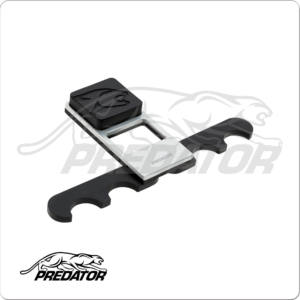
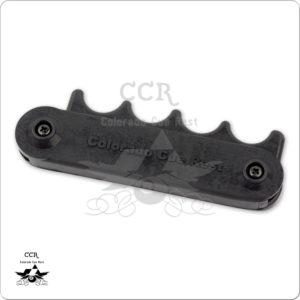
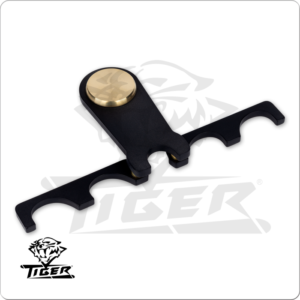
Most warped cues did their bending in plain sight, propped against the rail during practice or leaned on a windowsill between innings. Table-side holders solve this for a few dollars. The Q Claw single cue holder clamps onto the rail or any table edge and cradles the cue at a proper angle with the tip protected, and the two, three, and five cue versions handle a full family of players. For the game room wall, a rest like the Colorado four cue rest keeps the whole collection organized and straight, and the Tiger Paw five cue holder does the same with a little more style for the player whose cues outnumber their children.
Featured Cue Holders and Racks
-
-
-

-
Q Claw 1 Cue Holder
$12.95 Select options This product has multiple variants. The options may be chosen on the product page -
-
-
-
If you want a number to aim for, wood is happiest between roughly forty and sixty percent relative humidity. A cheap digital hygrometer tells you where your game room sits, and a small dehumidifier in a swampy basement or a humidifier in a dry winter climate costs far less than replacing a favorite shaft. Seasonal transitions deserve extra caution. When you carry a cold cue into a warm room, let it acclimate in its case for a few minutes before assembling it, the same way musicians treat a guitar arriving at a gig in January.
Travel Is Where Cues Go to Die
Storage at home is half the battle. The other half happens in transit, and this is where a real case earns its price. A quality case does three things a gym bag cannot. It supports the shaft and butt separately in padded tubes so nothing flexes, it insulates against the temperature swings of a car interior, and it protects the tip and ferrule from the impacts that come with car doors and pool hall floors. Hard cases give maximum protection for players who travel weekly, while padded soft cases cover the drive across town. If your cue still rides loose on the back seat, browse our full pool cue case collection and fix that before the next league night. A holder like the Predator cue holder even earns a spot in your bag for venues with nowhere safe to set a cue down.
A Two-Minute Monthly Routine
Once a month, give the cue a quick physical. Roll test on a flat surface. Wipe the shaft down with a barely damp microfiber cloth, then immediately with a dry one. Check the tip for mushrooming and glazing. Snug the joint gently and make sure the pin is clean. Look at the ferrule for hairline cracks. Then put it back in its holder or its case, somewhere climate controlled, standing straight. That routine takes less time than one rack of nine ball and it is the difference between a cue that plays true for thirty years and one that becomes a bar cue by its fifth birthday.
Cheap Insurance for an Expensive Habit
Players agonize over spending four hundred dollars on a cue and then store it like a garden rake. The economics are backwards. A holder costs less than a large pizza. A wall rest costs less than a league entry fee. A serious case costs a fraction of the cue it protects. Every cue in our pool cue collection, from a first Action starter to a Predator flagship, deserves the same twenty dollar bodyguard, because wood does not care what you paid for it. Straight is straight, and straight is a choice you make with storage. Grab a holder or rack, park the cue properly tonight, and the roll test will stay boring for decades. Boring is exactly what you want.

About Corey Bernstein
Corey Bernstein is a competitive pool player, billiards equipment specialist, and co-owner of Quarter King Billiards in Wilmington, North Carolina. With over a decade of experience in the sport, Corey has competed in regional APA and BCA sanctioned tournaments and maintains an intimate knowledge of cue construction, shaft technology, and table mechanics. As a certified dealer for brands including Predator, McDermott, Jacoby, Viking, Lucasi, Meucci, Joss, and Cuetec, Corey personally tests and evaluates every cue that comes through the shop. His hands-on approach to the business means he has racked thousands of hours behind the table — breaking in shafts, comparing tip compounds, and dialing in the nuances that separate a good cue from a great one. When he is not behind the counter or on the table, Corey is researching the latest advances in low-deflection technology, carbon fiber shaft construction, and cue ball physics. His articles on Quarter King Billiards combine real-world playing experience with deep product knowledge to help players at every level find the right equipment for their game.