 844 408 3056


 Hot Deal

A guy in a Tuesday night eight ball league gets a scratch call against him. Ball in hand, the whole table open. He drops the cue ball six inches from the nearest ball, a hanger sitting on the lip of the corner pocket, and pockets it without a thought. Two shots later he is hooked behind the eight ball with no shot and no safety, handing the table back. He had the most powerful tool in the game sitting in his palm and used it to shoot the one ball that mattered least.
That is what ball in hand gets wasted on more than anything else: comfort. A referee or your opponent calls a foul, and suddenly you can put the cue ball anywhere you want on the felt. Pros treat this as close to a guaranteed run out. League players treat it as permission to shoot the closest ball. The difference is not talent. It is whether you think about where the cue ball needs to end up before you think about which ball to shoot first.
What the Rules Actually Give You
In 9-ball and 10-ball under standard rules, a foul gives the incoming player ball in hand anywhere on the table, full stop. There is no restriction, no behind the head string rule, nothing. In 8-ball it depends on the rule set. Most modern rule books, the ones used in tournament play and a lot of leagues, also give ball in hand anywhere on the table after a foul. Some bar rules and older league formats only allow ball in hand behind the head string on certain fouls, which changes your options considerably. Before you assume you have the whole table, check your league’s rule sheet or ask the room. It takes ten seconds and it changes how you plan the next four or five shots.
Plan the Rack Backward Before You Put the Ball Down
The mistake in that Tuesday night story is common because it feels natural to shoot whatever ball is closest. The better habit is to look at the whole table first and work backward. Find the problem balls: the cluster near the side pocket, the ball frozen to the rail, the one sitting behind another that will block your path in three shots. Those are the balls that will end your run if you do not plan for them now, while the cue ball is still in your hand and you have total freedom.
Once you have spotted the problem balls, pick one and decide which ball needs a key position to deal with it. Everything else in your plan flows from that key ball. Only then do you look at the first shot and ask what cue ball placement gets you there. That is the entire skill of ball in hand: you are not just choosing where to put the cue ball to make one shot, you are choosing where to put it to set up a chain of shots that clears the table.
Placement Rules That Work Every Time
A few placement habits clean up your ball in hand game fast. Keep a comfortable distance to the first ball, close enough to see the angle clearly but far enough that a small stroke error will not cost you the shot. Avoid freezing the cue ball to a rail or leaving it somewhere you need a bridge. Keep a full cue ball on open cloth so your stroke stays normal.
Whenever you can, set up a stop shot or a slight angle rather than a shot that needs side spin to get position. A ball hit dead center that stops in its tracks, or one struck with a touch of stun, is far more predictable than a cut shot that relies on English to curve the cue ball where you need it. Save the fancy stroke for when there is no simple option left.
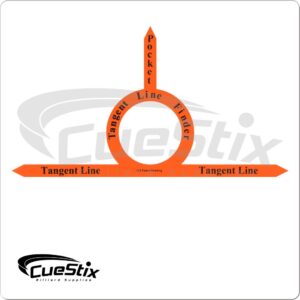
The reason cue ball placement controls your next shot comes down to the tangent line. On a stun shot, the cue ball leaves the point of contact along a line that sits at 90 degrees to the path the object ball travels. Change the angle you are shooting the object ball at, and you change that tangent line, and you change where the cue ball ends up. This is the whole trick behind good position play. You are not just picking a spot that makes the ball. You are picking the angle that sends the cue ball down the tangent line toward your next shot.

Every so often the right call is not the shot that scores you position, it is the shot that breaks up trouble. If two or three balls are jammed together, you can pocket a ball at low speed and let the cue ball drift gently into that cluster, spreading it out for later. You gave up a small amount of certainty on this shot to make the next five shots possible.
Most amateur mistakes with ball in hand come down to a short list: placing the cue ball too close to read the angle, reaching for spin when a natural stroke would work fine, and forgetting that a ball has to reach a rail or drop for the shot to count as legal. Place the cue ball with your hand, not the tip of your cue, and look at the whole table before you commit.
When Not to Run Out: The Ball in Hand Safety
Sometimes the balls are laid out badly enough that a full run is not really there, no matter how good your plan is. When that happens, ball in hand is still valuable, just for a different reason. Use it to play a lock up safety instead of gambling on a low percentage shot. Freeze the cue ball behind a blocker ball so your opponent has no straight look, leave the object ball tight against a rail so it cannot be pocketed easily, and put as much distance between the cue ball and the next shot as you can. A smart safety off ball in hand costs you nothing and can flip the whole rack back in your favor.
Two Drills That Make This Automatic
Set up a practice session around two drills. First, the run out drill: throw three balls anywhere on the table, take ball in hand, and run them, focusing on planning the order and the position for each shot before you touch the cue ball. Once that feels solid, move up to five balls, then seven. Keep score over ten attempts and track how many times you clear the table without a mistake in position.
Second, the stop shot drill. Place an object ball anywhere on the table, then place the cue ball for a straight in or near straight shot and try to stop the cue ball dead at contact. Do this for ten different object balls in ten different spots and watch whether the cue ball actually stops or drifts forward. This one drill will do more for your ball in hand game than almost anything else, because a dead stop shot is the single most useful position play there is.
Tools That Make Position Play Visible
The hard part about practicing ball in hand at home is that you cannot see the ghost ball position or the tangent line the way you can feel them at the table during a match. A few practice tools make those invisible things visible, which speeds up how fast you learn to place the cue ball on purpose instead of by feel.
The Ghost Ball Aim Trainer, $30, is a flat template that sits under and beside the object ball and shows exactly where the cue ball needs to be at contact, with arrows marking the cue ball and object ball paths. It is endorsed by Robert Byrne, whose instruction books have taught position play to generations of players, and it gives immediate feedback on the shot and the position that follows. The Tangent Line Trainer, $17.95, does the same job for the idea above: a ring fits around the object ball, you point the pocket line arrow at the pocket, and the tangent line arrows show, at 90 degrees, exactly where a stunned cue ball will travel.
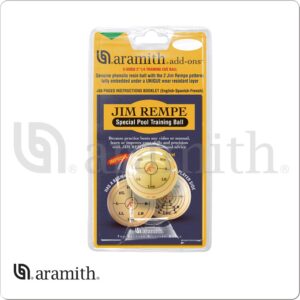
For spin control, the Pro English Trainer, $29.95, is a small horseshoe shaped gauge with numbered marks, zero at the center and then one, two and three tips each direction, that sits behind the cue ball so you can see exactly how far off center you are striking. The Jim Rempe Training Ball, $52.14, prints the same idea directly on a regulation cue ball, with target rings showing where to strike for draw, follow and side spin, plus an instruction booklet of drills. Named for former world champion Jim Rempe, it makes tip placement a visible habit instead of a guess.
Featured Practice Tools at Quarter King
-
Sale!
-
-
Sale!

-
-

-
-
Sale!
-
Make Ball in Hand Your Advantage
Ball in hand does not come around every game, but when it does, treat it like the gift it is. Slow down, find the problem balls, pick your key ball, and place the cue ball for the easiest shot that still sends it where you need it next. Pair that habit with a cue you trust from our full lineup of pool cues, add one or two of the practice tools above, and ghost ball position and the tangent line will be second nature before your next match.

About Corey Bernstein
Corey Bernstein is a competitive pool player, billiards equipment specialist, and co-owner of Quarter King Billiards in Wilmington, North Carolina. With over a decade of experience in the sport, Corey has competed in regional APA and BCA sanctioned tournaments and maintains an intimate knowledge of cue construction, shaft technology, and table mechanics. As a certified dealer for brands including Predator, McDermott, Jacoby, Viking, Lucasi, Meucci, Joss, and Cuetec, Corey personally tests and evaluates every cue that comes through the shop. His hands-on approach to the business means he has racked thousands of hours behind the table — breaking in shafts, comparing tip compounds, and dialing in the nuances that separate a good cue from a great one. When he is not behind the counter or on the table, Corey is researching the latest advances in low-deflection technology, carbon fiber shaft construction, and cue ball physics. His articles on Quarter King Billiards combine real-world playing experience with deep product knowledge to help players at every level find the right equipment for their game.