 844 408 3056

 Hot Deal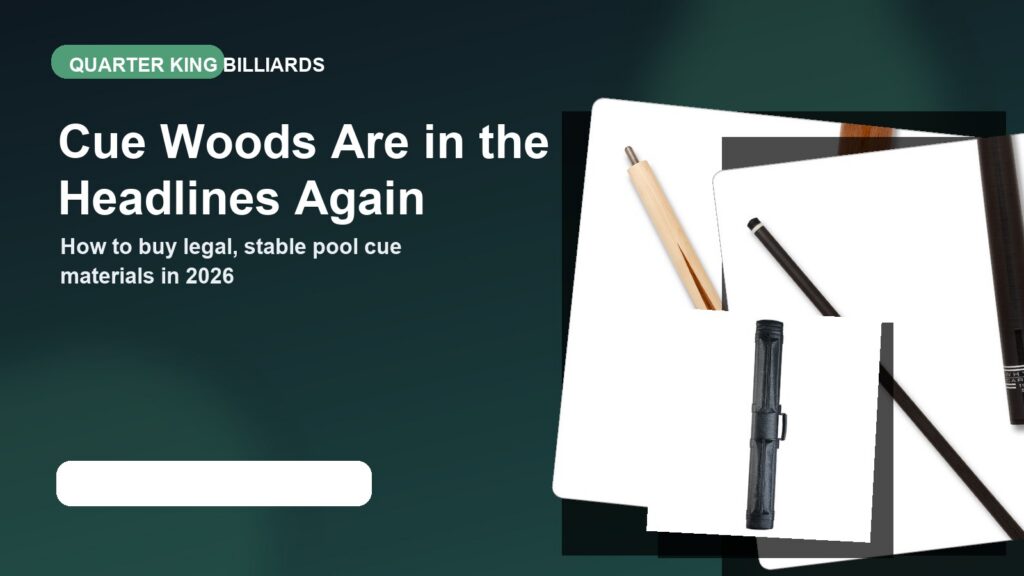
Pool players do not usually think about import law until a headline forces the subject onto the table. This week, a billiards business made news after being fined over protected wood imports, and while that case was not about the cues sitting in Quarter King Billiards’ inventory, it does underline a question players ask every time exotic materials hit the news cycle: what pool cue materials are actually smart to buy in 2026?
The short answer is that most players do not need to panic, but they do need to shop with a little more intention. The best cue purchase is not the one with the wildest species list on the spec sheet. It is the one built from legal, stable, well-understood materials that suit your game, your climate, and the amount of maintenance you are realistically going to give it. That is why many serious buyers today are comparing traditional maple, carefully sourced exotic accents, and modern carbon fiber shafts more closely than they did a few years ago.
Why the latest wood-sourcing story matters to cue buyers
Most cue buyers are not importing raw lumber themselves, but the supply chain still matters. When a cue maker or accessory company leans on restricted or heavily regulated species, the risk shows up in three places. First, availability gets inconsistent. Second, costs drift upward because compliant sourcing is harder. Third, long-term service and replacement become less predictable when a specific wood treatment or part is no longer easy to source. In other words, the headline may sound far away from your local league night, but it can affect what stays available, what rises in price, and what remains easy to support five years from now.
That is also why the mainstream buying conversation has shifted. Players still appreciate beautiful grain, points, veneers, and figured handles, but they are asking more practical questions now. Is the cue built around a stable core material? Is the shaft technology consistent? Is the brand going to be around to support the cue? Can I protect it with a proper case and sensible storage habits? Those questions are a lot more useful than chasing the rarest-sounding wood in the room.
The safest material bets for most players in 2026
For pure predictability, maple still matters. A well-built maple playing cue remains one of the easiest recommendations in billiards because the feel is familiar, the repair ecosystem is mature, and the market is full of proven models. If you want a traditional wood-playing experience without overcomplicating the purchase, a cue like the Meucci MESPN Sneaky Pete keeps things straightforward. You get a respected American cue profile, proven playability, and none of the confusion that comes from shopping deep into novelty materials.
Carbon fiber is the other major winner in this moment. If you are worried less about aesthetics and more about stability, a modern carbon shaft solves several problems at once. It shrugs off humidity better than unfinished wood, stays dimensionally consistent, and gives players a very repeatable feel from session to session. That is a big reason more buyers are moving toward products like the Whyte Carbon raw shaft or browsing the wider carbon fiber shaft lineup before they commit to another full wood build.
There is also a middle path that makes sense for many league players. You can keep the feel of a classic wood butt with tasteful point work or wrap choices, then pair it with more stable long-term accessories and storage. That approach preserves the traditional look most players love while reducing the maintenance headaches that come from treating a cue like indestructible bar furniture. A cue does not have to be made from rare or fragile materials to feel special in your hands.
What to ask before buying a cue with exotic woods
If a cue is being marketed around exotic species, do not treat that as an automatic red flag. Just ask better questions. Where is the wood being used, in the forearm, handle, points, or decorative inlays? Is it a structural part of the cue or mostly a cosmetic one? Is the cue maker established enough that future support is realistic? And most importantly, are you buying that cue for the way it plays or just because the species name sounds impressive?
Many players get themselves into trouble by buying a cue for romance instead of use. They picture the grain, the shine, the reaction from other players, then forget that the cue still has to survive trunk heat, league travel, and months of neglect between proper cleanings. If you are not the kind of owner who wipes a cue down regularly and stores it correctly, you are better off leaning toward stable modern builds and a better protection setup instead of the fussiest wood combination you can afford.
- Buy for playability first. The cue’s hit, balance, and shaft behavior matter more than the species list.
- Prioritize stable construction. Carbon fiber shafts and proven wood builds are easier to live with than fragile novelty setups.
- Think about serviceability. Established brands and common joints are easier to maintain over time.
- Protect the investment. A cue is only as durable as the way you store and transport it.
Your case and storage habits matter more than most players admit
Material conversations get most of the attention, but storage is what quietly decides whether a cue ages well. Even a smart material choice can be undone by heat, humidity swings, or careless travel. That is why a real case is not an accessory afterthought. It is part of the purchase. If you plan to keep a cue for years, browse QKB’s pool cue cases or go straight to a hard-sided option like the Lucasi LC22A leatherette 2×2 hard case. A stable cue stored badly is still a risk. A modest cue stored properly often outlasts the one that looked fancier on day one.
Small accessories help too. A set of joint protectors keeps connection points cleaner during travel, and a disciplined habit of keeping a cue out of hot cars does more for longevity than any marketing claim about miracle wood treatments. Players love to hunt for big equipment upgrades, but boring consistency usually wins here. Clean it, case it, and keep it out of temperature abuse.
How to shop smarter at Quarter King Billiards right now
If this week’s headlines pushed you to rethink materials, the practical move is simple. Start by deciding whether you want a traditional cue feel or maximum environmental stability. If you still love the classic hit of wood, look at dependable wood-forward options from proven brands like Meucci. If consistency and low maintenance matter more, start comparing the carbon fiber category. Then finish the purchase the right way with a real cue case and basic protection accessories.
The important thing is not to overreact to a headline. The cue world is not suddenly unsafe or untrustworthy. What the latest story does do is remind buyers that materials are part of a real supply chain, and the best buying decision is usually the least flashy one: legal sourcing, stable construction, proven brands, and smart storage. That is not boring. That is how serious players end up with gear they still trust years later.

About Corey Bernstein
Corey Bernstein is a competitive pool player, billiards equipment specialist, and co-owner of Quarter King Billiards in Wilmington, North Carolina. With over a decade of experience in the sport, Corey has competed in regional APA and BCA sanctioned tournaments and maintains an intimate knowledge of cue construction, shaft technology, and table mechanics. As a certified dealer for brands including Predator, McDermott, Jacoby, Viking, Lucasi, Meucci, Joss, and Cuetec, Corey personally tests and evaluates every cue that comes through the shop. His hands-on approach to the business means he has racked thousands of hours behind the table — breaking in shafts, comparing tip compounds, and dialing in the nuances that separate a good cue from a great one. When he is not behind the counter or on the table, Corey is researching the latest advances in low-deflection technology, carbon fiber shaft construction, and cue ball physics. His articles on Quarter King Billiards combine real-world playing experience with deep product knowledge to help players at every level find the right equipment for their game.