 844 408 3056

 Hot Deal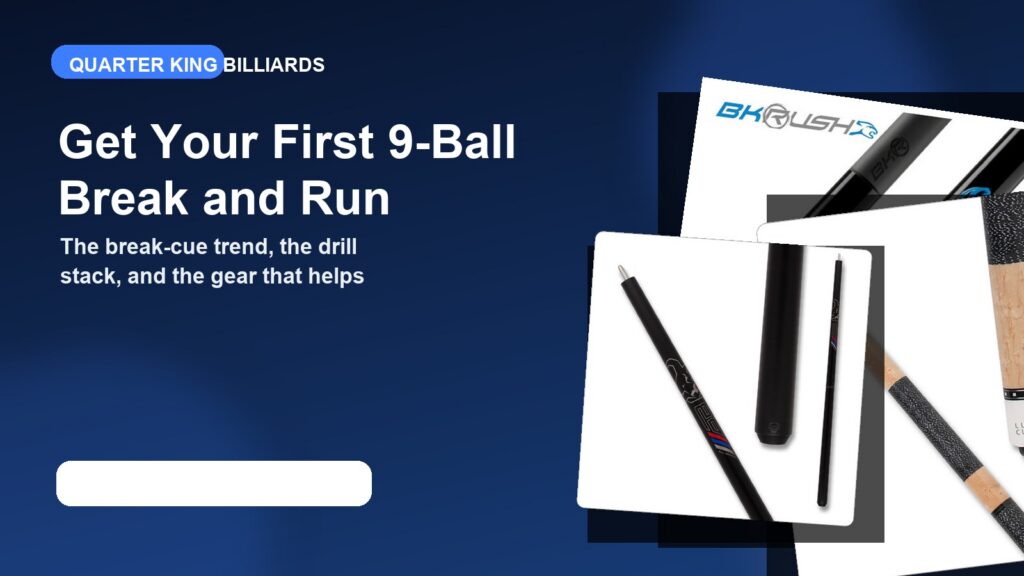
A fresh “first 9-ball break and run” clip bubbling up in r/billiards and steady Google Trends interest around terms like break cue, best break cue, Predator break cue, and BK Rush all point to the same reality: players are obsessed with turning one good opening shot into a full rack. That obsession is healthy. Getting your first break and run is one of the most useful milestones in pool because it proves your game is starting to connect, not just in shot-making, but in break control, pattern play, cue-ball routes, and discipline under pressure.
The mistake most players make is assuming the answer is only a new cue. A better break cue can help, but gear is the last piece of the sequence, not the first. If you want your first 9-ball break and run in 2026, you need three things working together: a break that creates predictable layouts, a plan for the first three balls, and equipment that supports repeatability instead of fighting it. That is why the smartest shoppers are not just browsing the break cue category. They are also upgrading chalk habits, tip maintenance, and how they practice the rack after the break.
What a first break and run actually requires
A break and run sounds like a shot-making achievement, but it is really a control achievement. Most players can make enough balls to run one open table now and then. What separates the players who convert more often is that their break leaves them choices instead of chaos. A controlled spread, a cue ball near center table, and one simple starter shot are worth more than a violent smash that makes a ball but sends the cue ball wandering into traffic.
That is why the goal is not “break harder.” The goal is “break cleaner.” Watch enough league matches and you will see the pattern. The player who wins more often is not always the one with the loudest hit. It is the player whose break gets the wing ball moving predictably, keeps the one ball findable, and leaves the cue ball with a chance to stop in a useful zone. Your first break and run usually comes right after your break becomes boring in the best possible way.
The break-cue conversation is real, but it needs context
Google Trends and shopper behavior both make it obvious that break cues stay hot. Searchers are comparing Predator BK Rush style builds, budget-friendly jump-break options, and carbon-heavy power cues because a dedicated break tool does make sense once your playing cue stroke is stable. A true break cue lets you hit more firmly with less fear of damaging your playing tip, and it often gives you a stiffer, more purpose-built transfer of energy into the rack.
But the upgrade only pays off if your mechanics deserve it. If your cue ball is flying off the table, if you are striking high or low by accident, or if you do not know where you want to stand after the break, a more expensive cue just gives you a cleaner way to repeat the same mistake. That is why many players should treat a break cue as an amplifier, not a shortcut. Once the motion is repeatable, the cue matters. Before that, the cue mostly exposes what you are already doing.
For players who are ready, there is a strong case for browsing purpose-built options such as the Cuetec Avid Surge break cue, the classic-market Lucasi L2000JB jump-break cue, or the broader QKB break cue selection. The right choice depends less on hype and more on whether you want a dedicated breaker, a jump-break combo, or simply a more durable second cue for league and tournament use.
The three-part drill stack that gets you there faster
If you are serious about your first break and run, practice has to mirror the actual sequence of the rack. Random ball potting will not do it. The cleanest path is to break the skill into three linked drills.
- Break and freeze. Rack nine balls, break, and do nothing else. Grade only the cue-ball finish and whether the one ball is available. Repeat until you can land the cue ball in a useful zone more often than not.
- Break plus first three balls. After the break, run only the opening pattern. If you lose shape by ball two or three, rerack. This teaches you that most break and runs are won by the transition, not by the final money ball.
- Full-rack pressure reps. Once the first two drills settle down, play sets where every open break becomes a committed runout attempt. No casual resets, no “that was close.” Either complete the rack or learn exactly where the pattern failed.
That sequence sounds simple, but it forces honesty. Players who say they are “close” to a break and run often discover they are really bad at only one tiny part of the chain, usually cue-ball height on the break or overplaying shape on the second shot. Fixing one small leak is often all it takes for the whole milestone to arrive.
Small gear habits that matter more than players think
There is a reason chalk, tips, and maintenance keep showing up in serious equipment conversations. A break-and-run attempt is unforgiving. If the tip is glazed over, if the chalk application is lazy, or if the shaft feels sticky through the bridge, your precision disappears right when you need it most. That is why it makes sense to keep your routine tight with good pool chalk and a reliable tip tool setup.
The same goes for protection. Players who travel with a second cue for breaking should stop tossing it loose into a trunk or wedging it next to bar gear. A clean break cue stays more consistent, and a dedicated case or at least proper separation in your main case keeps the wrap, finish, and joint in better shape over time. If you carry multiple pieces, QKB’s pool cue cases make that easier, and small items like break cue joint protectors help prevent avoidable wear.
How to know when you are close
Your first break and run usually announces itself before it officially happens. You start seeing the one ball more clearly after the break. You stop guessing where the cue ball will land. You begin getting through the first two shots without panic. Suddenly the table does not look crowded, it looks ordered. When that shift happens, the milestone is not far away.
At that point, your job is not to swing harder or hunt hero shots. It is to stay disciplined enough to let the rack come to you. Take the simplest starter. Stay below side pockets when possible. Accept a longer fourth ball if it preserves a natural angle on the five. A lot of first break and runs die because players get excited halfway through and try to prove the rack is easy. It is not easy. It is just available, and that is enough.
The best upgrade path for most league players
If you are building toward this milestone, the smart order is clear. First, stabilize the break motion. Second, practice the first-three-ball pattern religiously. Third, make sure your consumables are not holding you back with fresh chalk and proper tip maintenance. Then, if your stroke is ready for it, add a dedicated tool from the break cue lineup.
That is what the current break-cue trend is really about. It is not just gear lust. It is players realizing that one of the clearest jumps in pool happens when the opening shot stops being survival and starts becoming offense. Your first 9-ball break and run is not reserved for monsters. It belongs to the player who learns to make the break predictable, the first pattern calm, and the gear dependable enough to disappear into the background.

About Corey Bernstein
Corey Bernstein is a competitive pool player, billiards equipment specialist, and co-owner of Quarter King Billiards in Wilmington, North Carolina. With over a decade of experience in the sport, Corey has competed in regional APA and BCA sanctioned tournaments and maintains an intimate knowledge of cue construction, shaft technology, and table mechanics. As a certified dealer for brands including Predator, McDermott, Jacoby, Viking, Lucasi, Meucci, Joss, and Cuetec, Corey personally tests and evaluates every cue that comes through the shop. His hands-on approach to the business means he has racked thousands of hours behind the table — breaking in shafts, comparing tip compounds, and dialing in the nuances that separate a good cue from a great one. When he is not behind the counter or on the table, Corey is researching the latest advances in low-deflection technology, carbon fiber shaft construction, and cue ball physics. His articles on Quarter King Billiards combine real-world playing experience with deep product knowledge to help players at every level find the right equipment for their game.