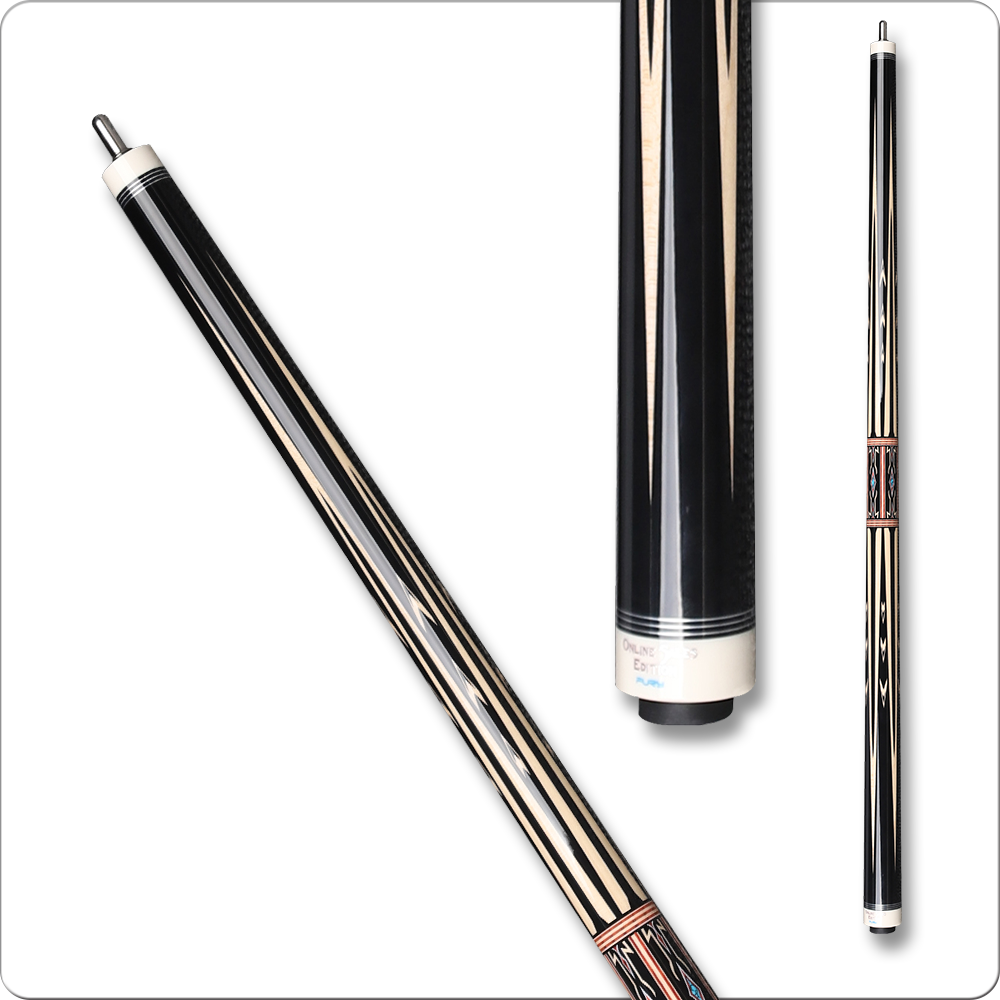
The Fury DC Series is a pair of wrapless, black-forearm play cues built around Fury's HTE 2.0 shaft and a proprietary quick-release joint. Both models we carry share the same construction and differ only in their point pattern. Here is what our own catalog and independent retailer spec sheets confirm about the shaft, joint, and warranty on each one.
Every item is brand new and 100% genuine, backed by its full manufacturer warranty. Free shipping on orders over $98 (contiguous US) and 30-day returns. Every spec on this page is checked against the manufacturer's published data by our Wilmington, NC store team.
Fury builds its cues at a factory in China and sells them through pool and billiards retailers across
the United States. Players discussing the brand generally on the AZBilliards forums describe a company
that has invested over the years in longer wood-seasoning times and CNC-based production, moving well
past an earlier reputation for painted-on points and occasional warping on its lowest-cost lines.
Comments on the brand's mid-tier models are more consistently positive, describing cues that stay
straight for years and hit well for the price.
The DC Series sits at a simpler, lower-priced point in Fury's lineup than the brand's wrapped, inlaid
cues: a plain black forearm with a spliced point pattern, no wrap on the handle, and Fury's own
quick-release joint rather than a standard threaded pin. Fury's current catalog site does not list a
series under the "DC" name today; its live navigation runs through a different, newer set of line codes
for its American pool cues. The DC name is still used consistently by independent pool and billiards
retailers that carry these exact two models, and their published spec sheets for the shaft, joint, and
forearm all match what is listed on our own product pages below. Fury's current site groups its cues
under two-letter or two-character line codes such as AM, TW, and GU, each tied to its own forearm
design; DC was one such code from an earlier generation of the lineup, following the same naming logic
the brand still uses even though this specific code is no longer part of the current catalog.
Sentiment toward Fury on the AZBilliards forums runs mixed, which is typical for a production brand
sold at several price points. Posts about the brand's lowest-cost, older cues mention painted-on points
or ring work that came loose over time, while more recent comments describe the mid-tier models as
straight for years of play and a strong hit for the money, with the improvement credited to changes the
brand made to its production process. None of those specific comments reference the DC Series by SKU;
they describe the brand's cues in general, and buyers weighing a lower-cost, no-wrap model like this one
should read that general sentiment as a reasonable guide to what to expect from the brand rather than as
a review of these two SKUs specifically.
The DC Series has fewer distinct parts than a wrapped, inlaid Fury cue: no wrap material to source
and finish, and a house-brand tip rather than a licensed third-party one, which is part of how the line
reaches a lower price point than Fury's decorated models. What is left is a straightforward two-piece
cue built around a solid shaft, a proprietary joint, and a spliced forearm pattern rather than a printed
one.
Both DC cues use a black forearm and butt sleeve, each with its own spliced point pattern in
contrasting woods rather than a printed design. The pattern is the only cosmetic difference between the
two models; the shaft, joint, tip, and wrap are identical.
The shaft on both cues is Fury's 29 inch HTE 2.0, a different platform from the STE shaft used on some
of the brand's other lines. It is finished with a white fiber ferrule and a 12.5mm Super Fury tip, Fury's
own house tip brand rather than a licensed third-party tip. A fiber ferrule is a common, inexpensive
ferrule material on production cues; it is durable under normal chalking and cue-ball contact, though
players who put a lot of hours on a cue sometimes upgrade to a denser ferrule material over time as it
wears.
Instead of a threaded pin, the DC Series uses what Fury calls a Quick Release, or QR, joint. A
quick-release joint lets the two halves come apart with a partial turn rather than several full
rotations of a standard threaded pin, which is a design choice aimed at faster assembly and breakdown
rather than at changing how the cue plays once it is together. Because it is Fury's own proprietary
fitting rather than a widely shared industry-standard pin, a replacement shaft for either DC model needs
to come from Fury directly; it will not interchange with cues built around a standard 3/8 x 10, 3/8 x
14, or radial joint, and it will not accept an aftermarket shaft designed for one of those industry-
standard pins either. That tradeoff, faster assembly against a narrower pool of replacement shafts, is
worth knowing before buying if you expect to shop aftermarket shafts down the road. A dedicated 29 inch classic wood shaft built for the Quick Release fitting is the
correct replacement part if a shaft is ever damaged, rather than a generic shaft pulled from an unrelated
brand.
Neither DC cue has a wrap. A wrapless handle exposes the forearm wood directly rather than covering a
section of it in linen, leather, or a synthetic composite, which gives a thinner, more consistent grip
profile at the cost of the moisture control a wrap provides during a long session. It is a common
construction choice on cues at this price point, since it removes a manufacturing step and a material
cost without changing the shaft or joint that do most of the work in how the cue plays; see our cue glossary for more on wrap types and other cue construction terms.
Both ship in four weights from 18 to 21 ounces and price at about $270. Neither includes a case or a
forward extension in the box, which is typical at this price point; both add-ons are sold separately if
wanted.
The Fury DC FUDC02 pairs the black forearm with maple
split points for a simple two-tone look, and it comes in Black, Grey, or Tan. It is out of stock with us
at the moment.
The Fury DC FUDC03 uses a busier pattern instead, with
multi-length brown and pearl points set into the same black forearm, offered in Black or Brown. It is
also out of stock right now.
Both DC cues share the same 29 inch classic wood HTE 2.0
shaft at 12.50mm, so a spare shaft from one model will fit the other.
The Quick Release joint is proprietary to Fury, so it does not correspond to any of the standard joint
sizes covered on our shafts page; a replacement or spare shaft
for either DC cue is best sourced from Fury rather than assumed to be universal. Because neither cue
carries a wrap, there is no wrap material to match if a shaft or joint repair is ever needed, only the
forearm finish.
Players discussing Fury cues broadly on the AZBilliards forums describe the brand's simpler, entry
production models as a straightforward, no-frills option: a good hit for the price without the inlay
work or wrap material that add cost elsewhere in the lineup. The DC Series fits that description well.
It suits a player who wants a two-piece cue with a quick-release joint for fast breakdown, does not mind
a wrapless handle, and is comparing options at a lower price point than Fury's decorated, wrapped
models. Some AZBilliards posters weighing production cues at this price point note that a comparably
priced cue from a US-based brand can come with a longer or more service-inclusive warranty than an
imported production cue typically offers; that tradeoff against the DC's lower price and quick-release
joint is worth thinking through before ordering, and it applies to most cues in this price range, not
just this one.
The 18 to 21 ounce weight range covers most adult players without needing a custom order, whether the
preference runs toward a lighter cue for touch and position play or a heavier one for a firmer break
from the same stick. Between the two models, the choice comes down entirely to which point pattern looks
better on the table, since the shaft, joint, tip, and wrap are identical.
Our own product records list the DC Series warranty as limited coverage, consistent with what
independent retailers publish for other Fury lines at this price. Coverage on an import production cue
like this typically excludes accidental damage, cosmetic wear, and warping caused by poor storage, so a
case is worth using between sessions even on a simpler, lower-cost cue like this one. Because neither cue
ships with a case, budgeting for one separately is worth doing at the same time, both to protect the
finish and to keep the joint clean between games.
The DC Series is the simpler, lower-priced of the two Fury lines we carry; for a wrapped cue with
genuine wood-spliced points and a linen-wrapped handle instead, see the Fury CX Series. For the rest of the
brand, including any other forearm patterns and weights Fury offers, browse all Fury pool cues, or step back to the full pool cues selection to compare the DC Series against production
cues from other brands at a similar price.
The DC Series has a plain black forearm, no wrap, and a proprietary quick-release joint, at a lower price than Fury's wrapped, inlaid lines like the CX Series.
A 29 inch HTE 2.0 shaft finished with a white fiber ferrule and a 12.5mm Super Fury tip, Fury's own house tip.
Only a shaft built for Fury's Quick Release joint will fit. It is a proprietary fitting, not a standard 3/8 x 10, 3/8 x 14, or radial pin, so a replacement should come from Fury.
No. Both models have a wrapless handle that exposes the forearm wood directly, which is a common construction choice at this price point.
Our own product records list the coverage as limited, which typically excludes accidental damage and warping caused by poor storage.
Learn about our up and coming Quarter King Billiards engineered products, get coupons to save $$$, stay up to date with our sales, and of course stay in the loop with our constantly changing used cues!