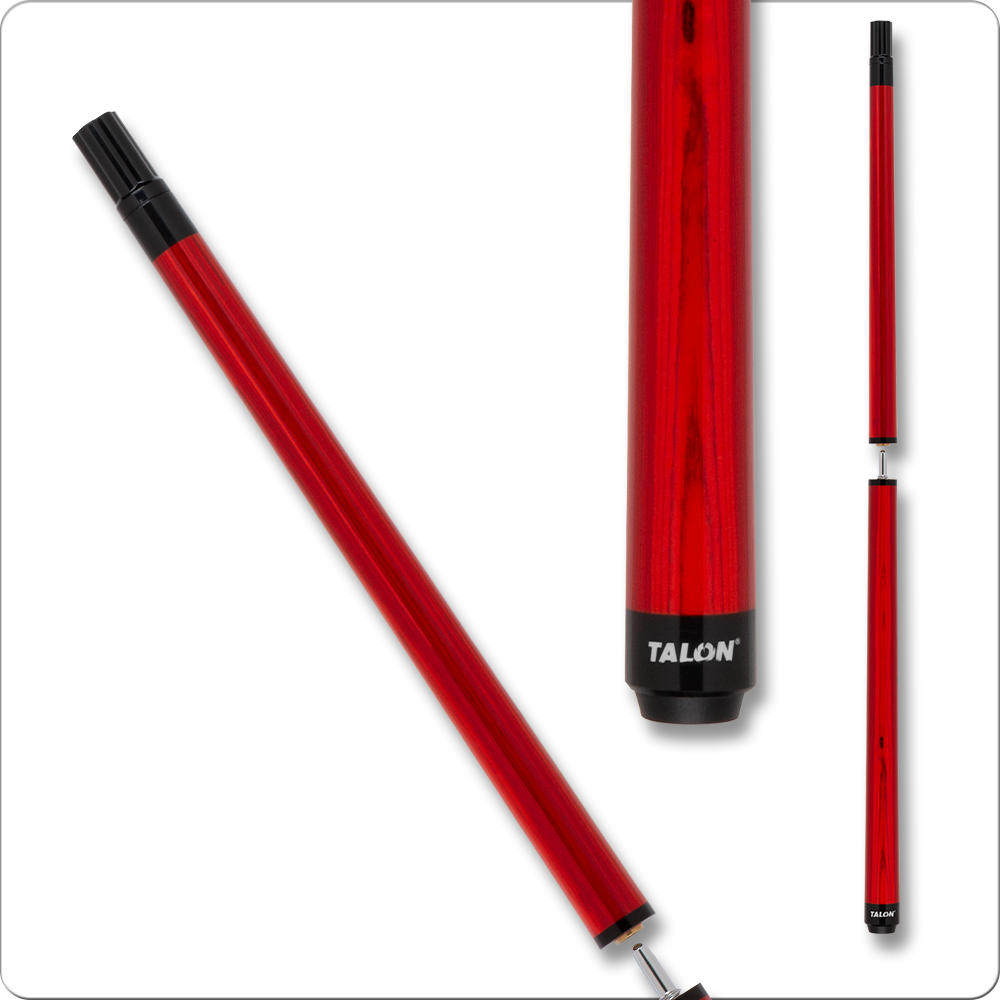
Talon Break & Jump Cues are Talon's combo answer to breaking and jumping in one stick, built on a conical-taper shaft, a phenolic Talon Break tip and a Radial joint. Quarter King carries all four colorways, the TLBJ01 through TLBJ04 in red, orange, blue and grey, and every one of them shares the identical spec underneath the finish. Talon files this line under its Specialty tier, separate from its numbered Playing cues. Below we cover what a conical taper and a phenolic break tip actually change, the full spec table for each colorway, and who tends to add a break-jump cue like this to their bag.
Every item is brand new and 100% genuine, backed by its full manufacturer warranty. Free shipping on orders over $98 (contiguous US) and 30-day returns. Every spec on this page is checked against the manufacturer's published data by our Wilmington, NC store team.
Talon organizes its cue line into two tiers: a standard Playing lineup of numbered entry-level cues, and a Specialty lineup that covers everything built for a job other than straight play. The TLBJ01 through TLBJ04 sit in that Specialty tier as Talon's dedicated break and jump cues, a single combo design offered in four colorways rather than four different builds. Talon's Playing cues are positioned as an affordable, consistent entry point into the hobby, and the TLBJ line extends that same value proposition into a two-job specialty stick: one cue that both breaks the rack and, with its removable joint, doubles as a jump cue.
All four colorways, red, orange, blue and the grey and black option, share an identical spec sheet underneath the finish. That is a deliberate simplification on Talon's part: rather than engineering separate break-only and jump-only cues, the brand built one break-jump platform and let color be the only real choice a buyer makes.
Talon's numbered Playing cues, the cues in our separate Talon Cues category, are aimed at a beginner buying a first real cue. The TLBJ line is a companion product to that lineup rather than a replacement for it: the idea is that a player who already owns a Talon or any other playing cue adds one TLBJ to the bag specifically to take over break and jump duty, so the wear from those two harder shots never touches the shaft they use to actually run out.
Every TLBJ cue mounts a 13mm phenolic Talon Break tip with a white break pad sitting just behind it. Phenolic is a hard, layered resin, and cue makers use it on break tips because it transfers far more of a swing's force into the cue ball than a softer tip absorbs. On a long-running AZBilliards thread about break and jump tips, opinions split: some players find a hard phenolic tip hits harder than anything else they have tried, while others say they get less control over the cue ball's landing spot compared with a softer synthetic tip, and switch tips specifically to fix that tradeoff. The white break pad behind the Talon tip is a separate cushioning layer meant to soak up some of that shock before it reaches the ferrule and shaft joint. For background on tip and ferrule terminology generally, see our glossary.
Backing the tip is a half-inch black phenolic ferrule, shorter and harder than the ferrule on a typical playing cue. A shorter, harder ferrule shows up repeatedly in AZBilliards discussions of what actually separates a break cue's construction from a playing cue's, alongside a stiffer taper and a harder tip, and Talon's spec follows that same pattern.
The TLBJ shaft runs 28.5 inches of color-matched pressed laminated maple with a conical break taper, meaning the shaft holds close to a constant diameter over its length rather than narrowing gradually the way a playing shaft does. Pressed laminated maple is built from layered wood pressed together rather than a single solid maple dowel, a construction that resists warping under the repeated stress of full-power breaking. AZBilliards posters who have tried both taper styles are divided: several say a conical taper feels noticeably stiffer and adds real power to a break, while others cannot tell the difference or simply prefer a pro taper's more familiar feel. Talon built the TLBJ line around the conical camp's preference.
All four TLBJ cues join at a Radial pin through a black collar rather than the more common 5/16x18 thread. A Radial joint uses a metal-to-metal connection designed to transfer hitting force with minimal flex at the joint face, a detail that matters more on a break cue than a playing cue since the joint absorbs a much harder impact on every swing.
None of the four colorways use a wrap. Instead, the pressed laminated maple forearm continues straight through to a matching butt sleeve, finished with a black butt plate carrying a silver Talon logo and a threaded, extension-ready bumper at the very end. That threaded bumper lets a player screw in a rear extension for extra reach and leverage on a break, or to convert the cue into a jump-cue configuration.
A dedicated jump cue is typically shorter and lighter than a break cue, built to be swung almost vertically over an obstructing ball rather than driven flat into a rack. Talon's TLBJ line handles both roles from one build by leaning on that threaded rear bumper: screwing in an extension lengthens the cue back out for a normal break stroke, while removing it shortens the cue for the steeper angle a jump shot needs. It is a compromise rather than a dedicated setup for either shot on its own, which is exactly why Talon prices the TLBJ as an affordable two-in-one rather than positioning it against a purpose-built jump-only cue.
| Model | SKU | Shaft | Wrap | Weight | Price | Availability |
|---|---|---|---|---|---|---|
| Talon TLBJ01, Red | TLBJ01 | 28.5" pressed laminated maple, conical break taper | Wrapless | About 20 to 21 oz | About $160 | Out of stock at the moment |
| Talon TLBJ02, Orange | TLBJ02 | 28.5" pressed laminated maple, conical break taper | Wrapless | About 20 to 21 oz | About $160 | Out of stock at the moment |
| Talon TLBJ03, Blue | TLBJ03 | 28.5" pressed laminated maple, conical break taper | Wrapless | About 20 to 21 oz | About $160 | Out of stock at the moment |
| Talon TLBJ04, Grey | TLBJ04 | 28.5" pressed laminated maple, conical break taper | Wrapless | About 20 to 21 oz | About $160 | Out of stock at the moment |
Beyond the color of the forearm and butt sleeve, there is nothing to choose between these four cues, so pick whichever finish matches a player's case or personal taste. Red and orange run brightest and show up clearly in a cue rack; blue sits a shade more traditional; the grey and black option splits the difference for a buyer who wants the break-jump spec without a loud color statement. All four currently show as out of stock in our system, so check back or reach out if a specific colorway is the one a customer wants.
Every TLBJ cue uses a Radial joint and a 13.00mm classic wood shaft. That Radial pin is a different thread standard than the 5/16x18 joint found on many of our other entry-level cues, so a TLBJ shaft will not simply thread onto a non-Radial butt, and a player who wants an extra shaft for this specific cue needs one built to the same Radial spec. Our full shafts selection is the place to check for a compatible replacement or spare.
A combo break-jump cue like the TLBJ line exists for a specific kind of player: someone who wants to protect their main playing cue's tip and shaft from the abuse of a full-power break, plus have a jump option on hand, without carrying three separate sticks to league night. AZBilliards threads on break and jump cue shopping repeatedly come back to the same short list of priorities, a stiffer shaft, a harder tip, and a joint that will not loosen under repeated hard impact, and the TLBJ's conical taper, phenolic tip and Radial pin check each of those boxes directly. It is a fit for a league or tournament regular who breaks hard and wants a dedicated stick for it, and for a player who has never owned a purpose-built break cue and wants to try one before spending more on a premium option. Players who already prefer a softer break tip for better cue-ball control, a real and ongoing debate among AZBilliards posters who weigh raw power against landing-spot control on the break, may want to budget for a tip swap down the line, since the stock Talon Break tip leans toward power over finesse.
Talon backs the TLBJ line with a limited manufacturer warranty covering defects in materials and construction, and each cue ships with a joint protector to keep the Radial pin clean between uses. As with any dedicated break-jump cue, expect the tip and break pad to wear from normal use well before any warranty question would come up, since that wear is exactly what the cue is designed to absorb instead of a player's primary shaft. All four TLBJ cues are made in China, the same origin as the bulk of Talon's numbered Playing lineup, keeping the price point consistent across the brand.
None of the four colorways ship with a case, so plan on a separate two-piece or wider case if the goal is to carry a TLBJ alongside a playing cue, particularly if the rear extension is being used and needs its own storage slot.
For Talon's numbered Playing cues, see the main Talon Cues category, and for every break, jump and playing cue we carry across every brand, browse Pool Cues.
The joint is what decides whether a shaft fits, and every cue in Talon Break & Jump Cues uses the Radial pin. That is the same Radial pin used across JFlowers, Jacoby and Universal, so shafts move between them — always confirm the exact pin before buying.
Nothing but color. The TLBJ01, 02, 03 and 04 use the identical 28.5 inch conical-taper shaft, phenolic Talon Break tip, Radial joint and wrapless build in red, orange, blue and grey respectively.
A 13mm phenolic Talon Break tip with a white break pad behind it, a hard combination built to transfer as much energy as possible into the cue ball on a full break.
Yes. Its threaded, extension-ready bumper lets a player remove the rear extension to shorten the cue for a jump shot, then screw it back in for a normal break stroke, covering both roles from one build.
A Radial pin through a black collar, a different thread standard than the 5/16x18 joint common on many entry-level cues, so replacement shafts need to match that same Radial spec.
Yes, Talon backs it with a limited manufacturer warranty against defects in materials and construction. Tip and break-pad wear from normal use is expected and is not a warranty issue.
Learn about our up and coming Quarter King Billiards engineered products, get coupons to save $$$, stay up to date with our sales, and of course stay in the loop with our constantly changing used cues!