 844 408 3056

 Hot Deal
Every player who has been around a pool hall for more than a month has been handed an aiming system. Ghost ball. Fractional overlaps. Contact point to contact point. The double the distance method. Someone will swear their system made them a shortstop, and someone else will tell you systems are a crutch and you should just feel it. Both camps are half right, and the part they usually leave out is the reason so many carefully aimed shots still miss.
The missing piece is that aiming and hitting are two different problems. You can aim a shot perfectly and still miss it, because the cue ball does not leave your tip on the line you aimed. That gap between where you pointed and where the ball actually went has a name, and understanding it fixes more misses than any new system will.
What the common systems actually give you
Ghost ball
Ghost ball asks you to picture an imaginary cue ball touching the object ball at the point directly opposite the pocket, then send the real cue ball to that phantom position. It is the most intuitive system because it maps directly onto what physically happens at contact. The weakness is that a floating transparent sphere is genuinely hard to visualize with any precision at distance, and small visualization errors scale up over eight feet of table.
Fractional aiming
Fractional aiming reduces the infinite range of cut angles down to a handful of reference overlaps. A full ball, three quarters, half, quarter, and the thin edge. Half ball is roughly a 30 degree cut, quarter ball is roughly 49 degrees, and the useful part is that you are lining up two solid objects rather than one solid object and one imaginary one. Most players find this more repeatable than ghost ball once they memorize the reference angles.
Contact point to contact point
This one has you find the contact point on the object ball and the corresponding point on the cue ball, then line the two together. It is precise in theory and awkward in practice, because the contact point on the cue ball is on the far side of the ball where you cannot see it while you are down on the shot.
The honest answer is that all three work, and none of them work if your stroke is not delivering the cue ball where your eyes said it should go. Pick the one that feels least like arithmetic to you and use it as a starting reference rather than a formula.
The deflection problem nobody warned you about
Here is where most aiming frustration actually comes from. The moment you hit the cue ball anywhere other than dead center, the cue ball does not travel down the line of your cue. It squirts sideways, away from the direction you applied the sidespin. Hit left english and the cue ball leaves slightly right of your aim line. This is cue ball deflection, often called squirt, and it is physics, not a mistake in your stroke.
Every shaft deflects the cue ball. How much depends mostly on the effective end mass of the shaft, which means how much weight sits in the last few inches near the tip. A heavy, thick front end pushes the cue ball off line more. A light front end, which is what low deflection shafts are engineered around, pushes it off line less.
Two players can aim identically, stroke identically, and miss in opposite directions purely because one is playing a traditional maple shaft and the other is playing a modern low deflection shaft. Neither is aiming wrong. They are compensating for different amounts of squirt without realizing they are compensating at all.
This is why switching shafts mid season feels like your game fell apart. Your brain has spent years building an unconscious correction for one deflection profile. Change the profile and every shot with sidespin goes to the wrong place until the correction rebuilds itself.
Featured Carbon Fiber Shafts
Carbon fiber shafts dominate professional play for two related reasons. They are engineered for low deflection, and they do not move with humidity, temperature, or time the way wood does. A maple shaft that plays beautifully in March can feel different in August. Carbon does not care. Here is what we carry.
-
Sale!
-
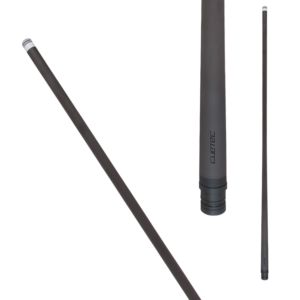
Cuetec CTCF Cynergy Cue Shaft – 12.5mm
Original price was: $499.00.$449.00Current price is: $449.00. Select options This product has multiple variants. The options may be chosen on the product page -
-
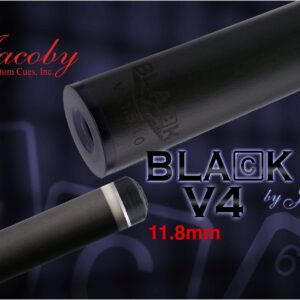
Jacoby BLACK V4 11.8mm
Price range: $475.00 through $510.00 Select options This product has multiple variants. The options may be chosen on the product page -
Sale!
-
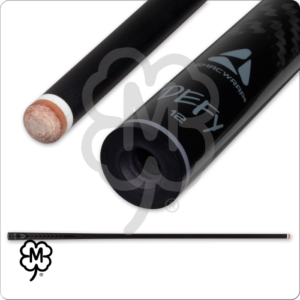
McDermott MCDCF Defy Carbon Fiber Shaft 12mm
Original price was: $455.00.$432.00Current price is: $432.00. Select options This product has multiple variants. The options may be chosen on the product page -
-
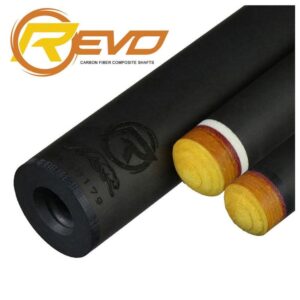
PREDATOR REVO CARBON SHAFT – 3/8 X 10
$549.00 Select options This product has multiple variants. The options may be chosen on the product page
Matching a shaft to how you already play
Diameter is the first decision and it matters more than most people expect. The Cuetec Cynergy at 12.5mm and the Predator Revo sit in the range most players coming from a standard 13mm maple shaft adapt to quickly. Drop to a slimmer profile like the Jacoby BLACK V4 at 11.8mm and you gain a smaller contact patch and easier access to extreme english, but you also gain less forgiveness on a slightly off center hit.
The McDermott Defy at 12mm and $432 is one of the more accessible entries into carbon, and it is a reasonable landing spot for a player who wants the stability without stepping straight to the top of the market.
Joint type is not a preference, it is a compatibility requirement. A Radial pin shaft will not thread into a 3/8 x 10 butt. Check your existing butt before ordering anything, and if you are not certain what pin you have, measure it or ask us. Our full shaft collection is organized so you can filter to the joint you actually need.
Maple is not obsolete
It would be easy to read all of this as an argument that everyone should be playing carbon. That is not the case. A well made maple shaft gives feedback through the hit that a lot of experienced players genuinely prefer, and the sound and feel of a solid maple hit is part of why they enjoy the game. Plenty of very strong players still compete with wood by choice, not by budget.
What maple asks of you is maintenance and tolerance. Wood moves. It absorbs moisture, it can warp if stored badly, and it will need cleaning and occasional attention to stay smooth. If you keep your cue in a car trunk through a Carolina summer, that is an argument for carbon regardless of how you feel about the hit. If your cue lives indoors in a proper case, maple stays perfectly stable for decades.
What a new shaft will not fix
A low deflection shaft will not fix a stroke that steers at the last moment. It will not fix a stance that drifts, a bridge that collapses under speed, or a habit of standing up before contact. All of those produce misses that look exactly like aiming errors, which is why players keep buying equipment when the actual problem is mechanical.
The cheap diagnostic is to have someone record you from behind on a phone for ten shots. Watch the tip at the moment of contact. If it is not moving in a straight line through the cue ball, no shaft in the catalog is going to help until that is addressed. Fix the delivery first, then let the equipment reduce the remaining error.
A practice routine that exposes your real aim
Set the object ball on the second diamond from a corner pocket and the cue ball roughly a diamond and a half away at a modest cut angle. Shoot the same shot ten times with dead center ball only. No english. If you are missing consistently to one side, that is an aiming or alignment problem and no equipment change will fix it.
Once center ball is reliable, shoot the same shot ten times with a half tip of left, then ten with a half tip of right. Watch which direction the misses go. That pattern is your personal deflection signature, and once you can predict it, you can aim for it deliberately instead of hoping. Most players discover they have been unconsciously overcompensating in one direction for years.
The point of a shaft upgrade is not that it aims for you. It is that it shrinks the size of the correction you have to make, and it keeps that correction the same tomorrow, next month, and in a different room with different humidity. Consistency is the product you are actually buying. If you are still building out the rest of the setup, our pool cue collection pairs with every shaft we stock.

About Corey Bernstein
Corey Bernstein is a competitive pool player, billiards equipment specialist, and co-owner of Quarter King Billiards in Wilmington, North Carolina. With over a decade of experience in the sport, Corey has competed in regional APA and BCA sanctioned tournaments and maintains an intimate knowledge of cue construction, shaft technology, and table mechanics. As a certified dealer for brands including Predator, McDermott, Jacoby, Viking, Lucasi, Meucci, Joss, and Cuetec, Corey personally tests and evaluates every cue that comes through the shop. His hands-on approach to the business means he has racked thousands of hours behind the table — breaking in shafts, comparing tip compounds, and dialing in the nuances that separate a good cue from a great one. When he is not behind the counter or on the table, Corey is researching the latest advances in low-deflection technology, carbon fiber shaft construction, and cue ball physics. His articles on Quarter King Billiards combine real-world playing experience with deep product knowledge to help players at every level find the right equipment for their game.