 844 408 3056

 Hot Deal
Ask ten league players what is in their case and nine will tell you about the cue. Ask what they do when the tip goes glassy halfway through a Wednesday night and most of them shrug, borrow something from the guy at table four, and hope it does not make things worse.
Cue tip tools are the cheapest meaningful upgrade in pool. A good one costs less than a case of soda and it is the difference between a tip that grips chalk and a tip that slides off the cue ball on the one shot you needed to draw the length of the table.
The Four Jobs, and Why They Are Not the Same
Every tip tool on the market does some combination of four things. Understanding which job you actually need is most of the decision.
Shaping
Shaping controls the curve of the tip. A new tip installed flat has to be rounded to a radius, and over months of play that radius flattens out as you wear the edges down. A flat tip means the contact patch moves unpredictably when you hit off center, which is exactly when you need it to be predictable.
The two standard radii are a nickel and a dime. Lay a nickel on the tip and match the curve for a flatter, more forgiving shape that suits break cues and players who mostly hit near center. Lay a dime on it for a tighter curve that lets you reach further off center for spin without miscuing. Most players should be on a dime. Break cues are the main exception, where a nickel spreads the impact and holds up better under repeated heavy hits.
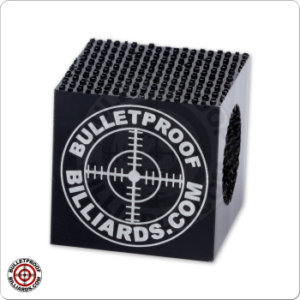
The Bulletproof Parabellum TTBPC shaper is a dedicated shaping tool with cutting surfaces that remove leather in a controlled way rather than grinding at it. Dedicated shapers cut faster and leave a cleaner edge than the shaping slot on a multitool, which matters when you are reshaping a tip that has gone properly flat. If you would rather work to a fixed radius, the Last 4 Ever TTL4D in the dime radius and the TTL4N in nickel machine the shape into the tool so you cannot drift off it.
Scuffing
Scuffing roughs the surface so chalk has something to hold onto. This is the job most players actually need and the one they most often skip. A tip that has been hit a few hundred times develops a compressed, polished face. Chalk sits on top of it instead of biting in, and you start getting miscues you cannot explain.
The fix takes about eight seconds. A few light passes with a scuffer, blow off the dust, chalk up. You are not trying to tear the leather. You are trying to open the pores.
Scuff when you notice chalk is not sticking or when you have miscued twice in a session on shots you normally make. For most players that is once every week or two, not every rack.
Burnishing
Burnishing hardens and seals the sides of the tip so it does not mushroom out over the ferrule. It is the opposite of scuffing and it applies to a different surface. You burnish the edge, never the striking face.
A mushroomed tip overhangs the ferrule, which changes how the tip compresses on impact and eventually leads to the tip separating. Trimming the overhang and burnishing the sides keeps the tip locked to its original diameter.
Picking and Aerating
A tip pick puts small holes in the surface to hold chalk. It is more aggressive than scuffing and it is the right tool for very hard tips, including phenolic-adjacent break tips and dense layered tips that resist normal scuffing. Use it sparingly. Overuse shortens tip life considerably.
Featured Tip Tools
-
Sale!

-
Last 4 Ever TTL4N Tip Tool -Nickel
Original price was: $25.00.$22.50Current price is: $22.50. Add to cart -
-
-
Sale!

-
Summit TTS01 Metal Tip Tool
Original price was: $23.85.$18.00Current price is: $18.00. Select options This product has multiple variants. The options may be chosen on the product page -
Sale!

-
Last 4 Ever TTL4D Tip Tool -Dime
Original price was: $25.00.$22.50Current price is: $22.50. Add to cart

Picking the Right Tool for How You Play
If You Only Ever Reshape
A fixed-radius tool is faster and more consistent than anything adjustable, because the shape is machined in and you cannot drift off it. The Last 4 Ever TTL4D in dime is the one most players should own, since a dime radius suits playing cues. Pick the TTL4N in nickel instead if you are maintaining a break cue or you prefer a flatter face. Match the radius to the cue and there is nothing left to think about.
If You Want a Slim Everyday Carry
The Cuetec Bowtie tip tool is about the size of a poker chip and disappears into a case pocket. It is a scuffer and light shaper rather than a heavy reshaping tool, which is honestly what most people need at the table anyway.
If You Want One Metal Tool That Lasts
Plastic-bodied tools eventually crack, usually in a case pocket under a cue. The Summit TTS01 metal tip tool is machined rather than molded, handles shaping and scuffing, and is heavy enough that you notice when it is missing. For a player who has already lost two cheap tools this year, that last part matters more than the specs.
A Maintenance Schedule That Actually Works
Every session: nothing. Chalk properly and play. Constant fiddling with a tip does more harm than good, and the single most common mistake is over-tooling a tip that was fine.
Every week or two: a light scuff if chalk is not holding. Two or three passes, no more.
Every month or two: check the edge for mushrooming. If leather is overhanging the ferrule, trim and burnish it back flush.
Every few months: check the radius against a coin. If it has gone flat, reshape it back to a dime.
When the tip is under about 1.5mm thick: stop maintaining and replace. A tip worn down near the ferrule hits dead and no tool will bring it back.
Your Tip Hardness Changes the Tool You Need
Not every tip wants the same treatment, and matching the tool to the leather saves you from wearing out a tip you just paid to have installed.
Soft tips compress more on contact and hold chalk well on their own. They need scuffing rarely and they mushroom faster than anything else, so the tool you will reach for most is a burnisher for the sides. Be gentle with abrasives. Soft leather gives up material quickly and you can take a season off a tip in one careless minute.
Medium tips are the default for a reason. They need a normal maintenance cycle: occasional scuffing, a reshape every few months, and edge burnishing when the sides start to bulge. A combination tool covers a medium tip completely.
Hard and layered tips hold their shape almost indefinitely, which sounds like an advantage until you realize they also hold a polished glaze that chalk will not grip. These are the tips that need a pick or an aggressive scuffer, and they are the reason those tools exist at all. If you are on a hard tip and you have never needed your scuffer, you are probably about to start miscuing.
Break tips are their own category. Phenolic and other very hard break tips should not be shaped with normal leather tools at all, and most of them never need reshaping. A light scuff for chalk adhesion is usually the entire maintenance program.
Two Mistakes Worth Avoiding
The first is treating every tip problem as a shaping problem. Players reach for the shaper when what they needed was a scuff, and they remove leather they will never get back. Ask whether the shape is wrong or whether the surface is just polished, and treat accordingly.
The second is using the tool on someone else’s cue without asking, or borrowing one in the middle of a match and applying it aggressively to a tip you are not used to. Tip feel is personal. A tip that has been reshaped by a stranger halfway through a race is going to feel wrong for the rest of the night.
Keep a tool in your case, use it less than you think you should, and your tip will play the same in month eight as it did in week one. That consistency is worth more than any single piece of gear at this price point.
Browse the full tip tools range, look at replacement cue tips when yours is past saving, or find something to carry it all in over in pool cue cases.

About Corey Bernstein
Corey Bernstein is a competitive pool player, billiards equipment specialist, and co-owner of Quarter King Billiards in Wilmington, North Carolina. With over a decade of experience in the sport, Corey has competed in regional APA and BCA sanctioned tournaments and maintains an intimate knowledge of cue construction, shaft technology, and table mechanics. As a certified dealer for brands including Predator, McDermott, Jacoby, Viking, Lucasi, Meucci, Joss, and Cuetec, Corey personally tests and evaluates every cue that comes through the shop. His hands-on approach to the business means he has racked thousands of hours behind the table — breaking in shafts, comparing tip compounds, and dialing in the nuances that separate a good cue from a great one. When he is not behind the counter or on the table, Corey is researching the latest advances in low-deflection technology, carbon fiber shaft construction, and cue ball physics. His articles on Quarter King Billiards combine real-world playing experience with deep product knowledge to help players at every level find the right equipment for their game.