Thirty seasons is a long time for anything in pool. Rooms close, tours fold, sponsors drift away. The Joss Northeast 9-Ball Tour has outlasted most of them, and this weekend it starts season number thirty with the Maine Event XVIII at TJ’s Classic Billiards in Waterville, Maine, running Saturday September 19 and Sunday September 20.
Tour director Mike Zuglan has been running this thing since the late 1990s. The opener follows the Turning Stone Classic XLII in Verona, New York, where Moritz “Hollywood” Neuhausen took the $10,000 top prize and Steve Fleming won the second chance event for $550. Verona is the tour’s showcase. Waterville is something different, and arguably more useful to look at, because it is the kind of event an ordinary league player can actually enter.
The format: races to 9 and races to 7, and why that gap matters
Every billiard room event on this tour is double elimination, with races to 9 on the winners side and races to 7 on the one loss side. That is not an arbitrary pair of numbers. It is a deliberate squeeze.
A race to 9 gives a weaker player room to catch a run. Break and run two racks, steal one on a mistake, and you are suddenly at 3 against a player who should beat you. Over nine games, variance has enough space to matter. That is the generous half of the bracket.
The loss side is where the tour tightens the screws. A race to 7 shortens every match you play after your first defeat, and you will be playing more of them than the undefeated players. So the moment you drop a match, the format starts punishing slow starters. If you need three racks to find your stroke, you are already down 3-0 in a race to 7 and the math has turned against you.
The practical lesson is simple and most first timers ignore it. Warm up properly before your first match, not during it. Get to the room early, get on a table, and shoot until your speed control is where it should be. The tour asks players to arrive on Saturday before 11:00 AM for sign in. Arriving at 10:58 is legal and it is also a mistake.
Two entry tiers, and the director decides which one you are
This is the part that confuses people the most, and it is worth explaining plainly. The Saturday and Sunday main event is $1,500 added. Entry is $120 for pro level players or $70 for non pro level players, and Zuglan decides which category you fall into. You do not self select.
That single design choice is why regional tours survive. A flat entry either prices out the amateurs or undercharges the pros. A two tier entry with a human making the call keeps the field mixed, which is the whole point of a regional stop. You want the room to hold both the player who might win it and the player who came to learn something.
There is also a $500 added second chance event on Sunday with a $20 entry, open only to non pro level players who were eliminated from the main event on Saturday. Read that carefully, because it changes your Saturday. If you are a non pro and you get knocked out on Saturday, your weekend is not over. You have a second, cheaper, shallower bracket waiting. Plenty of players have driven home Saturday night without realizing they had already paid for a hotel room and had a Sunday event available to them.
TJ’s owner Steve Reynolds and general manager Howard Fogg added $2,000 to the weekend between the two events. For a room in central Maine in September, that is real money and it deserves to be said out loud.
The dress code is not a suggestion
No t-shirts. No shorts. No sweat clothes. Jeans, sneakers, and a shirt with a collar or a billiard jersey are all fine at the tour’s billiard parlor events. Players do get turned away or sent to change, and it is an avoidable way to start a tournament badly.
The reasoning is not snobbery. A dress code is the cheapest signal a tour can send that the event is a competition rather than a Saturday session, and it changes how the room behaves. Players who are dressed for a match tend to act like they are in one.
Featured Joss Products

Why the tour carries the Joss name
Joss Cues has been the title sponsor across all thirty seasons, and the relationship goes deeper than a logo on a banner. Every billiard room stop on the schedule includes a raffle for a custom engraved collectible Joss cue valued at $1,800, and you do not need to be present to win. At Turning Stone, Art Wadsworth and Rick Manzi took the raffle cues home.
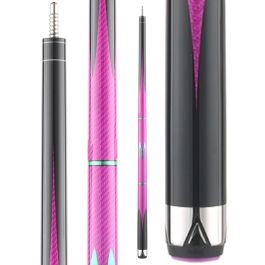
Joss builds in Richmond, New York, and the house style has stayed remarkably consistent. The playing cues share a common spec set: a 29 inch hard rock maple shaft with a pro taper, a 13mm tip, a three quarter inch Aegis linen ferrule, and a piloted 5/16×14 pin. That consistency is the actual selling point. A player who has shot a Joss for fifteen years can pick up a newer model and find the same hit waiting.

Choosing a Joss for a two day event
If you are building a kit for a weekend tournament rather than a Tuesday league night, the priorities shift. You will shoot far more balls than usual, across two days, on unfamiliar equipment.
The Joss JOS01 at $310.25 is the entry point into the line and the one most people should start with. Black forearm and butt sleeve, linen wrap, nothing decorative to pay for. It is the same shaft and joint as cues costing twice as much.
The Joss JOS61 at $352.75 moves into brown with a bit more inlay work, and the Joss JOS50 at $484.50 sits at the top of the practical range with more elaborate forearm work. None of these will play meaningfully better than the JOS01. You are buying appearance above the entry model, and there is nothing wrong with that as long as you know it.
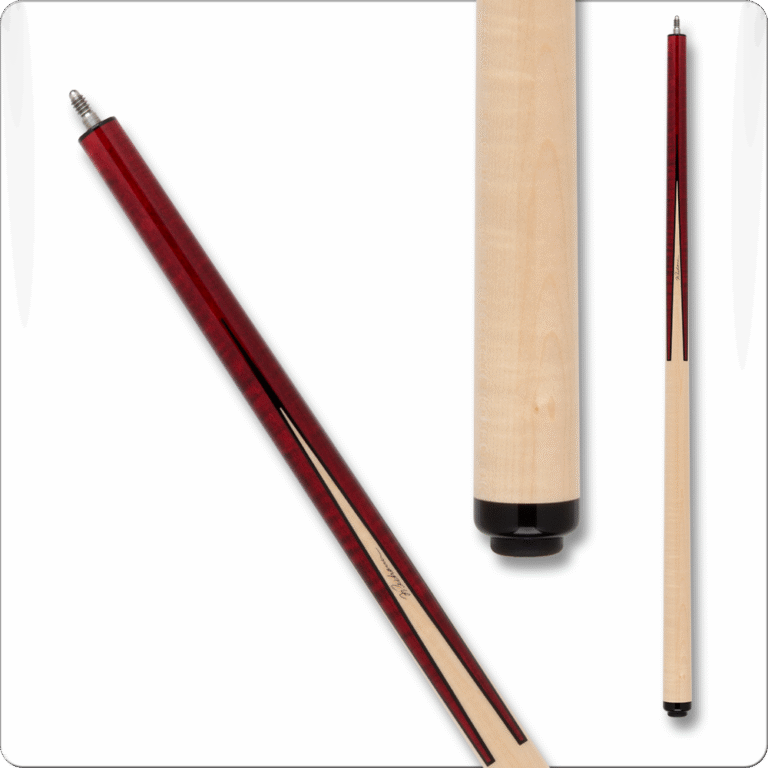
The one genuine performance addition is a dedicated break cue. The Joss Thor Hammer Break Cue in rosewood at $318.75 uses a 3/8×10 joint and a 13mm hard rock maple shaft. Over a two day double elimination bracket you might break sixty or eighty racks. Doing that with your playing cue is how good shafts get retired early, and a break cue is the single piece of gear most amateurs skip and most regulars own. If you want the understated route, the Joss JOSSP01 Sneaky Pete at $365.50 carries the same internals in a plain wrapless build.
What the room tells you before you shoot
TJ’s has been refreshed ahead of the opener with new carpet, all new table lights, and every table recovered in Simonis 860HR tournament blue. That last detail is the one to pay attention to.
Simonis 860HR is a high resistance worsted cloth. Fresh 860HR plays fast and holds very little nap, which means the cue ball travels further than it does on the fuzzy conventional cloth in most bar rooms. If you learned your speed on a napped table, your first hour on new 860HR will be a series of overruns. Every position shot will finish a diamond long until you adjust.
New table lights matter for a different reason. Consistent lighting across every table means you are not recalibrating your aim between rounds, which is a real problem in rooms where one corner is dimmer than the rest.
Three things to do before your first regional stop
First, sort your travel. TJ’s arranged a $99 rate at the Best Western Plus at 375 Main Street in Waterville. Mention the tournament when you book. Rooms are limited. Driving three hours on tournament morning is a choice that shows up in your stroke by round three.
Second, bring everything. A two day bracket does not pause while you find a tip pick. A playing cue, a break cue, spare tips or a tip tool, chalk you actually like, and a case that carries all of it without rattling. If your current case cannot hold two cues comfortably, that is worth fixing before the season rather than during it, and the cue case selection is the place to start.
Third, accept that you will probably lose on Saturday. Most of the field does. The value of a regional stop is not the payout, it is two days of matches against players better than the ones you beat on league night, with a clock and a dress code and consequences. That is the environment that makes players, and it costs $70.
For the full Joss Northeast 9-Ball Tour schedule and results, the tour publishes everything at joss9balltour.com. For everything else, a cue that will still feel the same in season thirty one is a reasonable place to start.
Browse the full pool cue collection at Quarter King Billiards, or go straight to the Joss cue lineup.

About Corey Bernstein
Corey Bernstein is a competitive pool player, billiards equipment specialist, and co-owner of Quarter King Billiards in Wilmington, North Carolina. With over a decade of experience in the sport, Corey has competed in regional APA and BCA sanctioned tournaments and maintains an intimate knowledge of cue construction, shaft technology, and table mechanics. As a certified dealer for brands including Predator, McDermott, Jacoby, Viking, Lucasi, Meucci, Joss, and Cuetec, Corey personally tests and evaluates every cue that comes through the shop. His hands-on approach to the business means he has racked thousands of hours behind the table — breaking in shafts, comparing tip compounds, and dialing in the nuances that separate a good cue from a great one. When he is not behind the counter or on the table, Corey is researching the latest advances in low-deflection technology, carbon fiber shaft construction, and cue ball physics. His articles on Quarter King Billiards combine real-world playing experience with deep product knowledge to help players at every level find the right equipment for their game.