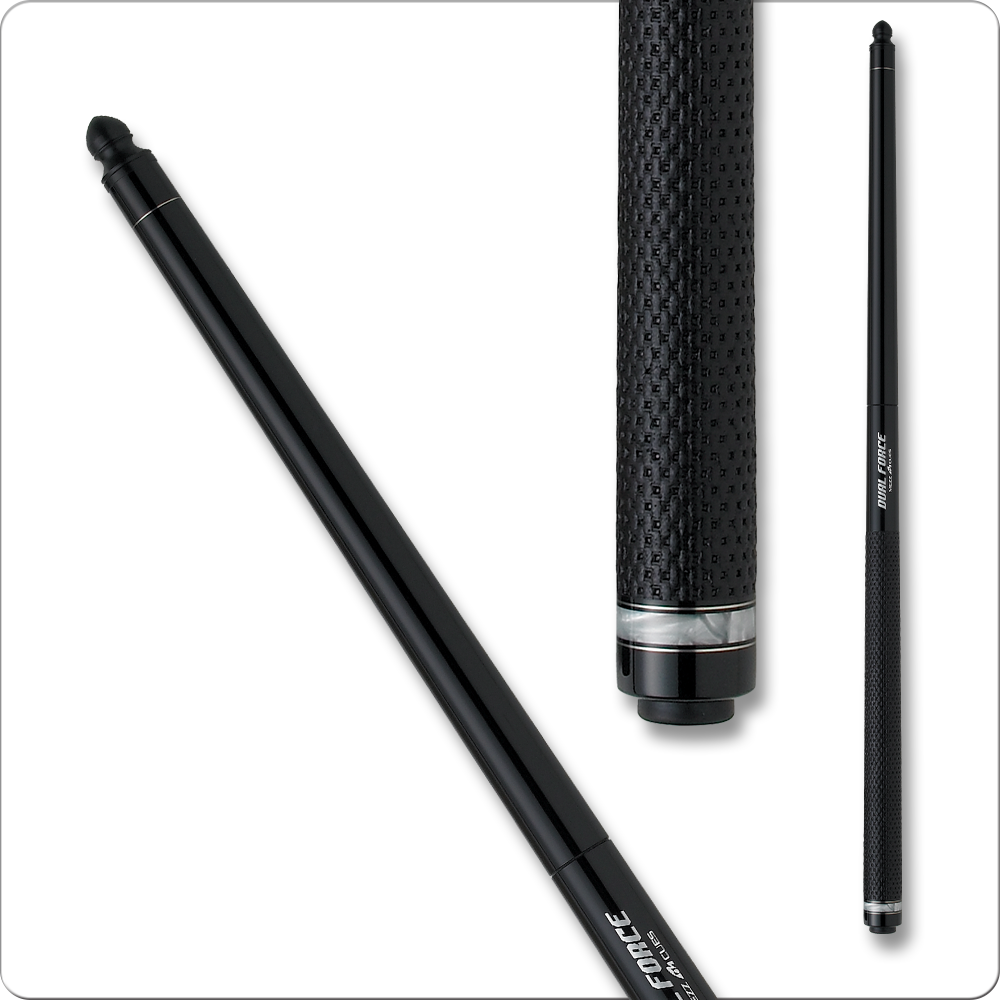
Dual Force is Mezz's combination break-and-jump cue, built around its own DF shaft, sonic ferrule and D2 joint rather than the United joint used on Mezz's playing cues. It's a practical pick for covering both shots with one cue.
Every item is brand new and 100% genuine, backed by its full manufacturer warranty. Free shipping on orders over $98 (contiguous US) and 30-day returns. Every spec on this page is checked against the manufacturer's published data by our Wilmington, NC store team.
Dual Force is Miki Co.'s combination break-and-jump cue, built entirely in Japan like every other Mezz model, designed to cover both roles in one piece rather than requiring a separate jump cue. It's built around Mezz's own DF shaft, a sonic ferrule and trance tip, a mesh leather grip, and Mezz's D2 joint system, distinct from the United joint used on most of the brand's playing cues. Miki Co. builds Dual Force in Japan, while the separate Mezz USA company, founded by players Caroline Pao and Mika Immonen in 2008, handles US sales and support.
The DF shaft is built specifically for break-and-jump duty rather than finesse play, paired with a sonic ferrule and trance tip designed to hold up under repeated hard break contact. Mezz sells that same DF shaft on its own as a spare, built with a 13mm Trance tip on a dedicated DF taper, in a 29 inch standard length with a joint protector included, for a player who wants a backup or is building a break cue around a different butt. Mezz's separate Deep Impact II break shaft runs on a different technology track: it pairs a sonic tip with a white TG1 Plate ferrule on its own DI taper, fits a standard United joint rather than Dual Force's D2 pin, and Mezz sells it as a final sale item that cannot be returned, so it is not an interchangeable part with the shaft on either cue we carry here.
Dual Force uses Mezz's D2 joint rather than the United joint found on most Mezz playing cues, a separate joint system built for this combination cue. Unlike United's piloted single-purpose design, the D2 pin is built around fast handle changes, which is what lets the same cue reconfigure between a short jump section and a longer one.
In place of a traditional wrap, Dual Force uses a mesh leather grip, which shows up in our own spec data as a wrapless cue even though there's a grip material on the handle.
Dual Force breaks down into three pieces rather than the usual two, so the shaft itself separates again inside its own jump section. That extra breakdown point is what lets one cue cover both a short jump shot and a longer one without swapping to a second cue.
Dual Force's forearm is a black high-impact composite material rather than wood, chosen because it needs to survive repeated hard break contact without cracking the way a natural forearm can over time. That same forearm splits off into a separate jump butt, which is the mechanical trick behind covering both break and jump duty with one cue.
The 7/8 inch black sonic ferrule and Trance tip work as a pair: the sonic ferrule widens the tip's impact area on the cue ball, and the Trance tip is paired specifically to hold up under that harder, flatter contact rather than to maximize finesse spin the way a softer playing-cue tip would. The D2 joint's pin is built around quick handle changes rather than one fixed configuration, which is what lets the same cue break down into different lengths for short and long jump shots.
A well-used Dual Force listed for resale on AZBilliards weighed about 19 ounces all up with its wrapless handle, joint protectors included and the same three-piece breakdown, which lines up with what Mezz lists for the cue new and suggests it holds its factory spec through regular play.
The mother-of-pearl band on the ZZDF's butt sleeve and the nickel ring on its collar are cosmetic touches rather than functional ones. What does the work on both cues is the black high-impact composite forearm and collar material, chosen for durability under break contact rather than for looks.
For more on how ferrules, tips and joint pins interact, see our glossary.
We carry two Dual Force cues: the ZZDF at about $590 and the ZZDFN, the no-wrap version, at about $770, matching Mezz USA's own listed price for the no-wrap Dual Force Break Jump Cue. Both are built for the same dual break-and-jump role; the price difference reflects the specific configuration rather than a difference in core technology.
Both Dual Force cues we carry share the same DF shaft, sonic ferrule, Trance tip and D2 joint. The difference between them is weight range and current availability. Mezz USA's own Break Cues navigation also lists Power Break G, Power Break Kai and Power Break II alongside Dual Force, none of which we currently carry.
The ZZDF comes in black, grey or silver, with a black high-impact collar and nickel ring, a thick mother-of-pearl band butt sleeve between two silver rings, and a black composite butt plate carrying Mezz's logo. It ships with a joint protector, offers two weight options, and is built in Japan under Mezz's limited warranty. It is out of stock at the moment, priced at about $590 when it returns.
The ZZDFN carries the same forearm, ferrule, tip and joint as the ZZDF, in black only, with four weight options instead of two, and the same joint protector and limited warranty. It is currently in stock at about $770, and it is the configuration Mezz USA itself sells directly online.
Both Dual Force cues use Mezz's D2 joint, a 13.00mm classic wood DF shaft, and are wrapless under our attribute data. If you need a replacement shaft in that diameter, check our full shafts category.
Dual Force suits a player who wants one cue that covers both breaking and jumping instead of carrying two separate specialty cues. It trades the finesse-oriented WX-Sigma shaft used on Mezz's playing cues for a shaft and ferrule built specifically to survive repeated hard contact, so it's a practical pick for league or tournament play where both shots come up. One brand-wide caveat is worth factoring in regardless of joint type: Mezz has declined requests to offer its low-deflection Ex Pro shaft with other brands' joints.
Because Dual Force uses Mezz's own D2 joint rather than the United joint on Mezz's playing cues, a standard United-joint shaft will not thread onto it, so any replacement or backup shaft needs to be built specifically for the D2 pin. AZBilliards resale listings for used Dual Force cues consistently describe them as lightly used and well cared for even after regular play, which is itself a mild vote of confidence in how the cue holds up over time.
On the AZBilliards forums, players discussing Mezz's break-and-jump cues generally agree the design rewards real breaking technique rather than doing the work by itself, with one longtime poster describing a similarly built Mezz break-jump cue as an explosive breaker that also jumps well, and preferring it over a Predator BK3 in his own comparison.
The same threads frame a combination cue like Dual Force as a tradeoff by design: a dedicated break cue and a dedicated jump cue can each edge it out at their single job, so Dual Force's appeal is carrying one cue instead of two rather than out-hitting a purpose-built break cue on power alone.
The same AZBilliards consensus applies beyond playing cues: a cue repair technician who handles a large volume of production cues each year has said no other production brand matches Mezz for consistency, a reputation that extends to the D2-jointed break and jump side of the lineup as well as the United-jointed playing cues.
The same forum discussion that rates Mezz's quality equal to Schon and says Mezz holds resale value well was not talking about a specific model, but the sentiment applies as much to a break and jump cue bought to keep for years as it does to a primary playing cue.
Mezz USA publishes the same warranty terms for Dual Force as the rest of its current lineup: one year against manufacturing defects, backed by a 14-day satisfaction or replacement window for cues purchased directly through Mezz USA. Miki Co.'s own site lists a considerably longer non-transferable limited lifetime warranty for the original purchaser, manufacturer language published separately from Mezz USA's US terms.
A combination cue is also simply a matter of storage and travel convenience: one case slot instead of two, at the cost of neither role being quite as specialized as a dedicated break cue or a dedicated jump cue would be on its own. For a league player who only occasionally needs a jump shot, that tradeoff is usually worth it.
See the rest of Mezz's current playing and break cues in Mezz pool cues, or compare against other break cue options in our general pool cues category.
Dual Force is a combination break-and-jump cue, built to cover both roles in one piece rather than needing two separate specialty cues.
Dual Force uses Mezz's D2 joint, a different system from the United joint on most Mezz playing cues.
Our ZZDF runs about $590 and the no-wrap ZZDFN about $770, matching Mezz USA's own listed price for that no-wrap configuration.
Mezz USA publishes a one-year manufacturing-defect warranty, plus a 14-day window on direct orders. Miki Co. in Japan separately lists a longer lifetime warranty.
Yes. It is built as a combination cue with a forearm that splits into a separate jump butt. AZBilliards players note it rewards real breaking technique rather than doing the work on its own.
Learn about our up and coming Quarter King Billiards engineered products, get coupons to save $$$, stay up to date with our sales, and of course stay in the loop with our constantly changing used cues!