 844 408 3056

 Hot Deal
Twenty-seven players walked into Action Billiards in Inman, South Carolina on Saturday, August 29 for a $250-added stop on the Q City 9-Ball Tour. Two of them, Steven Kelley and Mike Vinesett, walked out with the top two checks after agreeing to split rather than play a final. Kelley, who was sitting in the hot seat when the deal was struck, goes into the books as the official winner. It was the first time his name has ever appeared in the AZBilliards results database, which tracks cash finishes across the country. Vinesett had one prior entry, a fourth-place finish on the same tour in July.
That is the whole story on paper, and Skip Maloney’s write-up for AZBilliards on September 4 gives it the attention a small regional event rarely gets. The reason it deserves a closer look is that this is exactly the kind of tournament most players in eastern North Carolina and upstate South Carolina will play before they ever see a 128-player open. If you have been thinking about stepping up from league night to a cash-payout weekend, the Inman bracket is a useful map of what that step looks like.
How a handicapped regional bracket actually works
The Q City 9-Ball Tour, run by tour director Herman Parker, uses a handicap system where lower-rated players receive “beads on the wire,” meaning games already credited to them before the match begins. Kelley raced to 4 in every match he played, but his opponents’ race lengths changed depending on their rating. In his second match he faced tour veteran Onyx Stinson, who was racing to 8. Kelley started with four beads, so the effective race was 4 to 8, and it still went double hill before Kelley closed it out.
In his next match he had three beads in a race to 7 against Rob Hart and did not need a single one of them. He shut Hart out. In the hot seat match against David Honeycutt he had one bead in a race to 5 and again won 4-0 without using it. That pattern matters. A spot is insurance, not a plan. The players who move up the regional ladder tend to be the ones who play as if the beads are not there.
Vinesett’s route tells the other half of the story. He gave up just two racks in his first two matches, then survived a double-hill winners’ side quarterfinal against Daniel Bradley at 4-4 with one bead in hand. He lost to Kelley 4-2 in their only meeting, dropped to the loss side, and then had to grind through both Hixon brothers: Kirk at 4-4 with Kirk racing to 7, then Kaleb at 4-5 in the quarterfinal with three beads in a race to 7. His semifinal win over Honeycutt at 4-1 set up the split. Six wins, one loss, and every one of the close ones decided by a rack or two.
Three things the Inman bracket teaches a league player
The race length changes your shot selection
A race to 4 is short. Four racks can be over in twenty minutes, and one dry break or one missed 9 can swing the entire match. Players coming from an APA or BCA league format where a night lasts three hours are often surprised by how little margin there is. The practical adjustment is to treat every opening rack like it is the hill. Kelley shutting out two opponents 4-0 was not luck. It was the result of not giving away a rack early and then having to chase.
Double hill is a skill, not a coin flip
Two matches in this bracket are recorded as double hill, Kelley over Stinson and Vinesett over Bradley, and several more came down to a single rack. The players who consistently win double-hill games have a routine they do not abandon under pressure. They chalk the same way, they take the same number of practice strokes, and they play the safety when the runout is not there instead of firing at a low-percentage shot because the match is on the line. If you want to prepare for a regional event, play practice sets that start at hill-hill. One rack, winner takes it, then rerack and do it again.
Splits and the “official” winner are part of the culture
When Vinesett came through the loss side, he and Kelley agreed to split the top two prizes rather than play a race that would have kept the room open another hour. This is common on regional tours, and the convention is that the hot seat occupant is recorded as the official winner. Nobody should be surprised or offended by it. If you are the one asked to split, know your own answer before you get there. Some players always play it out because they want the match reps. Others take the money. Both are fine, but decide in advance so the question does not rattle you.
The equipment lesson from a cash-payout weekend
League cues live comfortable lives. They sit in a locker or a closet, they get pulled out once a week, and the room is climate controlled. A regional tour cue lives in a car trunk in South Carolina in late August, gets carried into a room that may or may not have the air conditioning working, and then has to deliver the same hit at 11 p.m. that it delivered at noon. That is the environment where a carbon fiber shaft earns its keep. Carbon does not absorb moisture, so its deflection and feel do not drift over a long day, and it does not warp in the trunk on the drive home.
For a player making this step, the Bull Carbon lineup is one of the more sensible places to look because it puts a full carbon shaft on the table at a price that does not require a four-figure commitment. Every playing cue in the range uses a 29-inch M30 carbon shaft with Bull Carbon’s Cross Lateral Technology layup, a 16-inch pro taper, a 2mm Juma ferrule, and a Uni-Loc pin for a fast, positive lockup. The differences between models are mostly cosmetic and in the handle.
The Bull Carbon BCLD4 at $665.99 pairs an ice blue forearm and butt sleeve with a black leather wrap and stainless collar. The BCLD3 and BCLD14 sit at the same price with silver and emerald finishes respectively, and all three carry a 10-year limited warranty. If you prefer a wrapless handle and a plainer look, the BCLD6 sneaky pete at $656.99 hides the same carbon shaft under a four-point maple butt that would not look out of place in a bar box league.
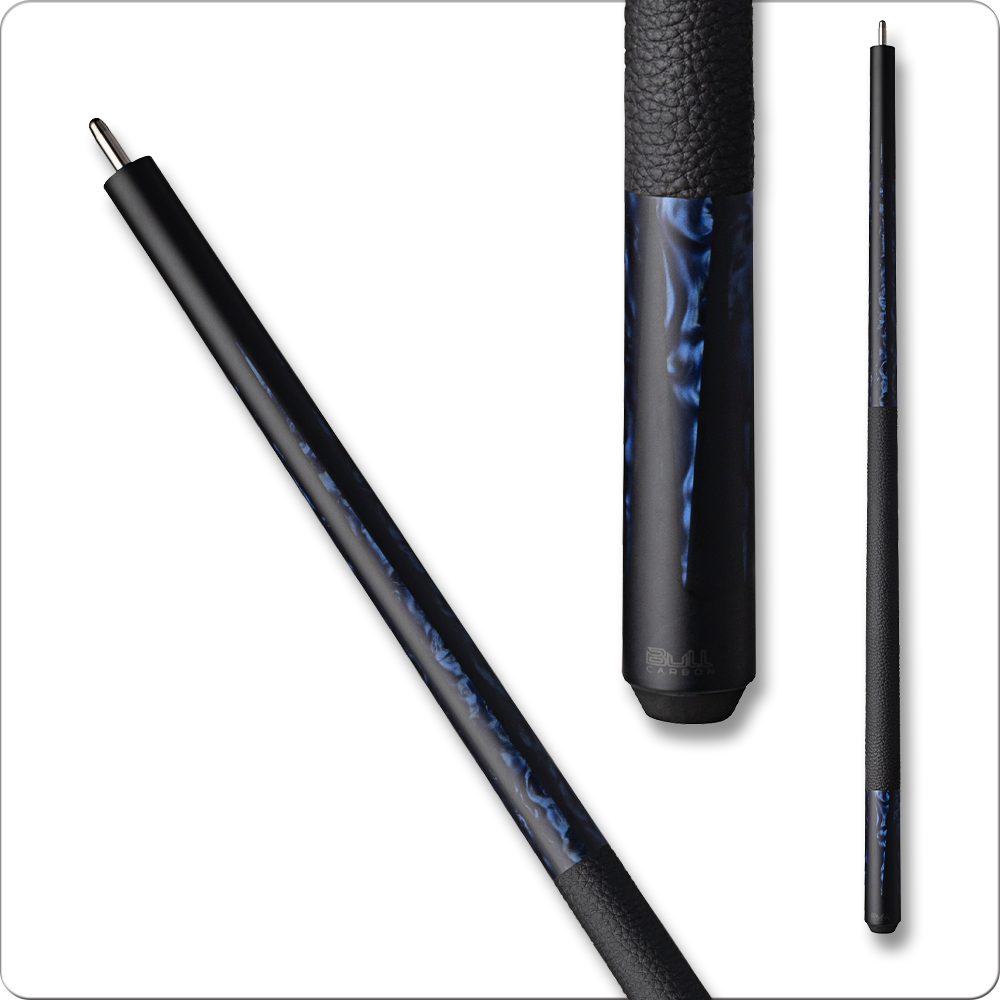
At the top of the range, the Bull Carbon BCL10 at $1,079.10 steps up to a 12.25mm Kamui Black soft tip and a matte black butt with six long blue and black swirl inlaid points, no wrap. The smaller tip diameter and soft tip give a player who relies on sidespin more grip and more feedback, which is a fair trade for a cue that will be the last one you buy for a long while.
Featured Bull Carbon Products
-
Sale!

-
Bull Carbon BCL10 Carbon Fiber Pool Cue, Black, No Wrap
Original price was: $1,119.00.$1,079.10Current price is: $1,079.10. Select options -
Sale!

-
Bull Carbon BCLD4 Carbon Fiber Cue
Original price was: $739.99.$665.99Current price is: $665.99. Select options
What to bring besides a cue
The Inman field broke in races that started as short as 4, and on a 9-ball table the break decides a large share of those racks. If you have been breaking with your playing cue, a regional event is the moment to stop. A dedicated break cue such as the Bull Carbon BCBKW break cue at $629.10 keeps the hard hits off your playing tip, and it lets you use a firmer tip built for the job. Our break cue category has options across every budget if that one is more cue than you need right now.
Beyond that, the kit is short. A tournament-grade chalk, a small towel, a tip tool, and a case that can take a day in the car. Spend your preparation time on the table, not in the shop. Play sets of short races against the best player you can find, practice hill-hill racks until the pressure feels normal, and get comfortable playing safeties when the runout is not there. Those are the skills that turned Kelley’s beads into a hot seat he never had to use them for.
Where the Q City Tour goes next
The tour went right back to Action Billiards in Inman for another $250-added event on Saturday, September 5, and Parker’s schedule runs stops across the Carolinas through the year. For Wilmington-area players, that is a reasonable drive for a weekend of competitive 9-ball with a handicap that gives a newer player a real chance to cash. Sponsors on the August stop included TKO Custom Cues, Digital Pool, and AZBilliards, and the brackets are typically run through Digital Pool, so you can study past stops before you enter.
If you need to be honest about your own equipment before you go, our full pool cue catalog covers everything from first cues to the carbon fiber shafts that can bring an older butt up to modern performance. Bring what you have, play the beads like they are not there, and see where the ladder takes you.

About Corey Bernstein
Corey Bernstein is a competitive pool player, billiards equipment specialist, and co-owner of Quarter King Billiards in Wilmington, North Carolina. With over a decade of experience in the sport, Corey has competed in regional APA and BCA sanctioned tournaments and maintains an intimate knowledge of cue construction, shaft technology, and table mechanics. As a certified dealer for brands including Predator, McDermott, Jacoby, Viking, Lucasi, Meucci, Joss, and Cuetec, Corey personally tests and evaluates every cue that comes through the shop. His hands-on approach to the business means he has racked thousands of hours behind the table — breaking in shafts, comparing tip compounds, and dialing in the nuances that separate a good cue from a great one. When he is not behind the counter or on the table, Corey is researching the latest advances in low-deflection technology, carbon fiber shaft construction, and cue ball physics. His articles on Quarter King Billiards combine real-world playing experience with deep product knowledge to help players at every level find the right equipment for their game.