 844 408 3056

 Hot Deal
Most home tables are delivered with a set of balls thrown in, and most owners never think about them again until the cue ball turns yellow and the eight has a chip you can feel with a fingernail. That is a shame, because the ball set is the one piece of equipment every single shot passes through, and the difference between a bargain polyester set and a proper phenolic set shows up in three places you care about: how the balls react, how long they last and what they do to your cloth.
This guide explains what phenolic resin actually buys you, walks through the Aramith range as it exists in our store today, and ends with a straightforward recommendation for each type of table. If you have ever stared at six Aramith sets that all look identical in the photos and wondered why one costs seven times more than another, this is for you.
Why the material matters more than the brand name
Nearly every serious ball set in the world is made from phenolic resin, and the overwhelming majority of those are made by one company in Belgium under the Aramith name. Phenolic is a thermoset plastic: once cured it does not soften with heat, which is exactly what happens at the point of contact when two balls collide at break speed. Cheaper sets use polyester or polyacrylic resins that are softer, absorb chalk into the surface, pick up burn spots where friction heats the cloth, and go out of round as they wear.
Three consequences follow. First, consistency. A set where every ball is the same weight and the same diameter to tight tolerances plays the way physics says it should. Cut angles, throw and speed off the rack all behave predictably. Second, durability. Aramith has long claimed a service life several times that of polyester, and anyone who has run a pool room will tell you a phenolic set outlasts multiple recovers. Third, and this is the one nobody thinks about: cloth wear. A hard, glossy, through-hardened ball glides across the nap. A soft, chalk-impregnated ball drags, leaves white marks, and burns tracks on the break. Buying a cheap set to protect a nice cloth is backwards.
Reading the Aramith ladder
Every Aramith set we carry is regulation 2 1/4 inch, made in Belgium from Aramith phenolic resin. What changes as you climb the range is the grade of resin, the manufacturing tolerances and, at the top, the Duramith process.
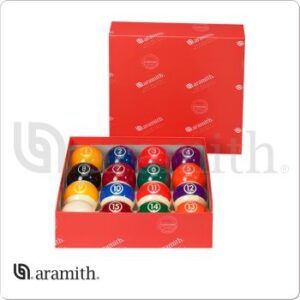
The Aramith Continental set is the entry point at about $65. It is real Aramith phenolic, made with the company’s Premier grade resin, and it is the set to put on a home table when the alternative is the no-name polyester set it came with. Replacement balls are available individually, which is not something you can say about the bargain sets. For a family table that gets weekend use, it is a big upgrade for very little money.
The Aramith Crown Standard set, listed in our store as the Crown Belgian set, sits one rung up at roughly $128. Same Premier grade resin, slightly tighter production standards and the classic Aramith look. We also stock a Crown Standard set with a Tournament magnetic cue ball, which is the version to buy if your table is a coin-operated bar box that separates the cue ball by magnet. Standard cue balls will not return on those tables, so this pairing saves a headache.
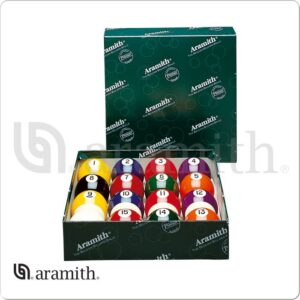
The Aramith Premier set at about $195 is the sweet spot for a serious home player. This is the grade the Continental borrows its resin from, but here the whole set is built to the Premier standard, and it is the most common set found on well kept home tables. If you practice with purpose and want the balls to reward good speed control, this is the sensible floor.
The Aramith Premium set at about $214 uses Aramith’s Premium resin and comes with a matching Premium grade cue ball. It is a modest step up from Premier in surface finish and durability, and it is worth the small difference if the table sees daily play.
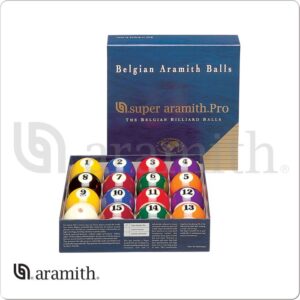
The Super Aramith Pro set at roughly $350 is where the range turns professional. Super Pro phenolic resin, the tightest tolerances in the standard range, and the set that spent decades as the benchmark for tournament play before the Tournament line arrived. For a pool room, a league venue or a home player who competes, this is the set that removes equipment as an excuse.
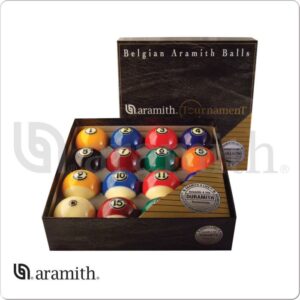
The Aramith Tournament set at about $455 is the current top of the line. It is built with Duramith technology, which Aramith describes as its fourth generation resin, with a reworked formulation and curing process that extends service life by up to 50 percent over previous sets. The surface is through-hardened and vitrified, so the balls keep their gloss, hold their rebound and playing consistency across the set, and minimize the cloth wear and white marks that make an older set look tired. This is the set used at major professional events and the one to buy if you never want to buy balls again.

The value packs and the measles ball
The Aramith Tournament Pro Cup Value Pack bundles the Tournament set with three extras that serious players end up buying anyway: the six red dot Pro Cup cue ball you see on every televised match, which lets you read your spin on the screen and at the table; the Jim Rempe training cue ball with its instruction booklet, one of the best speed and spin teaching aids ever made; and a ball cleaning and polishing kit. At about $518 it is cheaper than assembling the pieces separately, and for anyone building a practice room it is the smartest single purchase on this page. If you already own a good set and only need a replacement, magnetic or oversized cue ball, our cue balls category carries Aramith and Predator cue balls on their own.
Where Predator Arcos fits
The one non-Aramith set in our lineup is the Predator Arcos ball set at $419. Predator engineered these phenolic 2 1/4 inch balls for tournament grade weight and roundness consistency and for color vibrancy that holds up under camera lights; they are the balls used at Predator’s own professional events. If you play mostly on Predator equipment or simply prefer the brighter color scheme, Arcos is a legitimate alternative to the Super Pro and Tournament sets rather than a step down.
Which set for which table
For a home table that sees casual weekend play, buy the Continental or the Crown Standard and put the savings toward a good cloth brush and a decent rack. For a home table where someone is actually practicing, the Premier or Premium is the right floor, and the Tournament Value Pack is the right ceiling. For a coin-op bar box, the Crown Standard with the magnetic cue ball solves the return problem, or pair any set with a magnetic cue ball. For a league room, a pool hall or a competitive home player, Super Aramith Pro or Tournament. The extra durability pays for itself in cloth alone.
Making a set last
Phenolic balls are tough, not indestructible. Clean them regularly with a dedicated ball cleaner rather than household abrasives, which dull the finish and make the surface grab chalk. Wipe the cue ball between sessions, because it takes ten times the hits of any object ball and accumulates chalk fastest. Watch for the classic warning sign on coin-op tables: a cue ball that has worn visibly smaller than the object balls, which changes how it throws off every cut. Aramith sells replacement singles for every set on this page, so a lost or damaged ball does not mean a new set. Finally, rack properly. A loose rack does not just hurt your break; it lets balls collide at odd angles that chip cheaper sets. Our racking guide covers wood, aluminum and template racks.
Featured Ball Set Products
-
Sale!
-
Aramith BBSAP Super Pro Ball Set
Original price was: $438.82.$351.05Current price is: $351.05. Add to cart -
Sale!
-
Aramith BBPR Premier Ball Set
Original price was: $243.84.$195.07Current price is: $195.07. Add to cart -
Sale!
-
Aramith BBCONT Continental Ball Set
Original price was: $80.85.$64.68Current price is: $64.68. Add to cart -
Sale!
-
Aramith BBAT Tournament Ball Set
Original price was: $568.61.$454.89Current price is: $454.89. Add to cart
The short version
If the balls on your table did not come in an Aramith box, upgrading them is the highest impact change you can make to the table short of new cloth, and it protects the cloth you already have. Start at the Continental if the budget is tight, land on the Premier if you practice, and go to Super Pro or Tournament if you compete or run a room. Browse the full ball sets collection, explore the rest of our billiard accessories, or, if the balls are already handled and it is the cue holding you back, head over to our pool cues collection.

About Corey Bernstein
Corey Bernstein is a competitive pool player, billiards equipment specialist, and co-owner of Quarter King Billiards in Wilmington, North Carolina. With over a decade of experience in the sport, Corey has competed in regional APA and BCA sanctioned tournaments and maintains an intimate knowledge of cue construction, shaft technology, and table mechanics. As a certified dealer for brands including Predator, McDermott, Jacoby, Viking, Lucasi, Meucci, Joss, and Cuetec, Corey personally tests and evaluates every cue that comes through the shop. His hands-on approach to the business means he has racked thousands of hours behind the table — breaking in shafts, comparing tip compounds, and dialing in the nuances that separate a good cue from a great one. When he is not behind the counter or on the table, Corey is researching the latest advances in low-deflection technology, carbon fiber shaft construction, and cue ball physics. His articles on Quarter King Billiards combine real-world playing experience with deep product knowledge to help players at every level find the right equipment for their game.