A regional 9-ball open means three cues going into one bag: the playing cue, the break cue, and the jump cue, plus whatever low deflection shafts you don’t want to leave in the car. That’s the moment a 2×4 stops working and a 3×5 case becomes the only real option, and it’s also where the choice gets harder: five 3×5 cases in this comparison, three different coverings, two very different levels of crush protection, and a price spread from $229.00 to $503.20.
Why 3×5 Is the Tournament Player’s Size
A 3×5 case holds three butts and five shafts: room for a playing cue, a dedicated break cue and a jump cue, plus spare or low deflection shafts. League players who only carry one cue are better served by a 2×4 or smaller case. But once the break cue and jump cue live in the bag full time, which is exactly the kit most regional open players carry since jump cues are legal in most 9-ball opens, the extra shaft slots stop being a luxury and start being the reason you’re not leaving gear in the trunk. This comparison skips the general case size breakdown and goes straight to five 3×5 models from the cue case collection: material, protection, carry weight and price.
Leather, Vinyl and Hard vs Semi-Rigid, Explained
Before comparing models, it helps to know what the spec sheet words actually mean. Genuine leather is the heaviest and most expensive covering on this list, but it wears in over time, resists scuffs, and is the traditional look you see on tournament tables. Vinyl and leatherette are synthetic coverings instead: lighter, cheaper, and easier to wipe down after a long session, though both can crack or peel after years of sun and abuse. A hard case has a rigid tube or shell built to protect against crushing, while a semi-rigid or soft case trades some of that crush protection for a lighter, more flexible bag. The Instroke hard cases support each butt and shaft in its own slot so cues don’t knock together in transit. None of that is marketing filler once you’re loading a case for a weekend tournament: a hard shell is what keeps a butt straight if the case gets set down hard on a tile floor or tossed in a trunk with other bags, while a lighter semi-rigid build is what keeps your shoulder from complaining by the third round of the day.

Instroke Buffalo and Cowboy: The Leather Standard
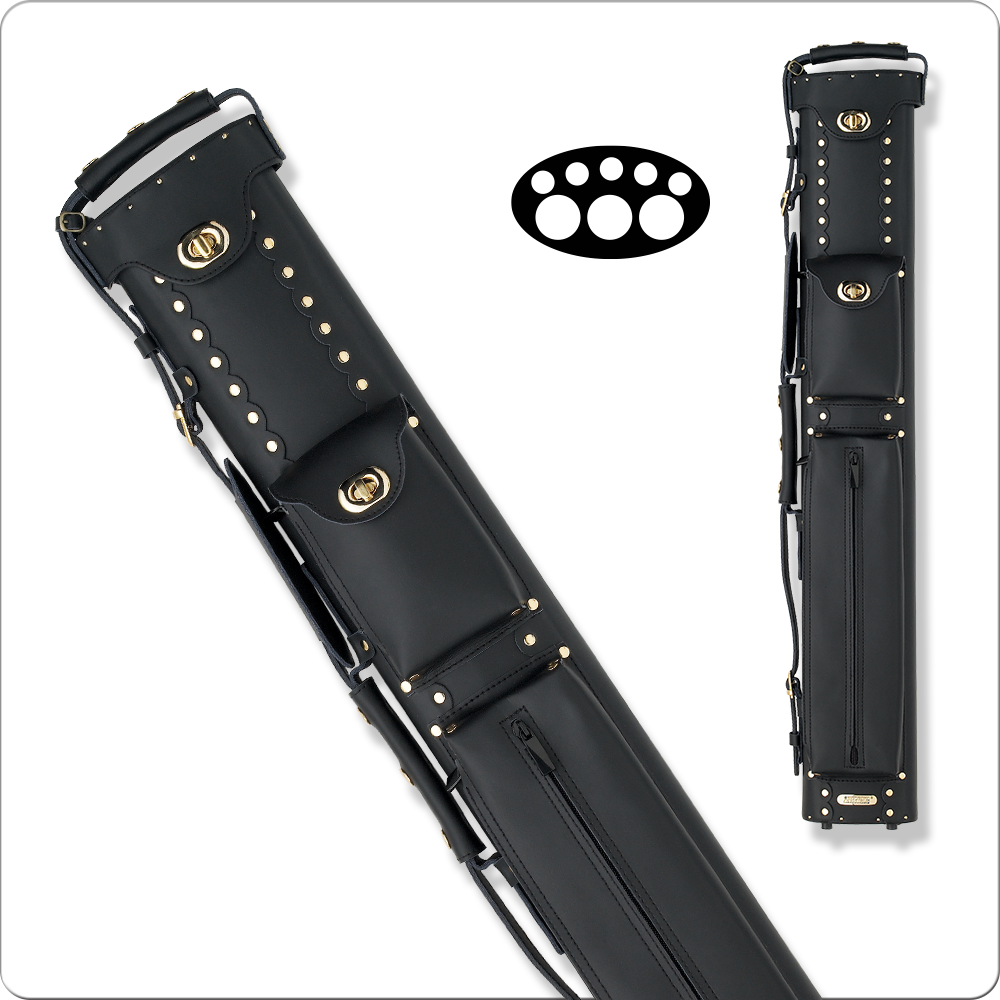
The Instroke 3×5 Buffalo Leather ($463.20) is genuine brown and tan leather over a hard case, built for three butts and five shafts with a clasp top. It carries two exterior pockets, the longest running 15 inches, a total case length of 34 inches, and room for shafts up to 31 inches. A shoulder strap, a side carrying handle and a top carrying handle cover every way you’d actually move it through a venue, and the interior is hard-sided, supporting each butt and shaft individually. Instroke describes it as a case you buy once and use for years.
The Instroke 3×5 Cowboy Leather in black ($439.20) matches the Buffalo spec for spec: hard case, clasp top, two exterior pockets up to 15 inches, a 34 inch total length, a 31 inch shaft fit, and the same shoulder strap, side handle and top handle. The only real difference is the leather color and finish, plus a mixed black and brown version offered at the same $439.20. Pick Buffalo for the brown and tan traditional look, Cowboy for all black. Both sit in the Instroke cases lineup alongside the brand’s other 3×5 leather and vinyl options.
Instroke’s 3×5 range doesn’t stop at Buffalo and Cowboy. The Southwest leather (ISSW35) is the priciest case in this whole comparison at $503.20, a third genuine leather option for a player who wants a different look than plain brown/tan or all black. The Leather 3×5 Hard Case in black and white (ISCL35) runs $431.20, landing just under the Cowboy on price with the same leather-and-hard-case construction. Line those two up against Buffalo and Cowboy and the pattern holds: every Instroke leather case in 3×5 uses the same 34 inch total length and the same 31 inch shaft fit, so the decision between them really does come down to color and how much you want to spend on leather.
Lizard Vibrant Series: Lightweight and Loud
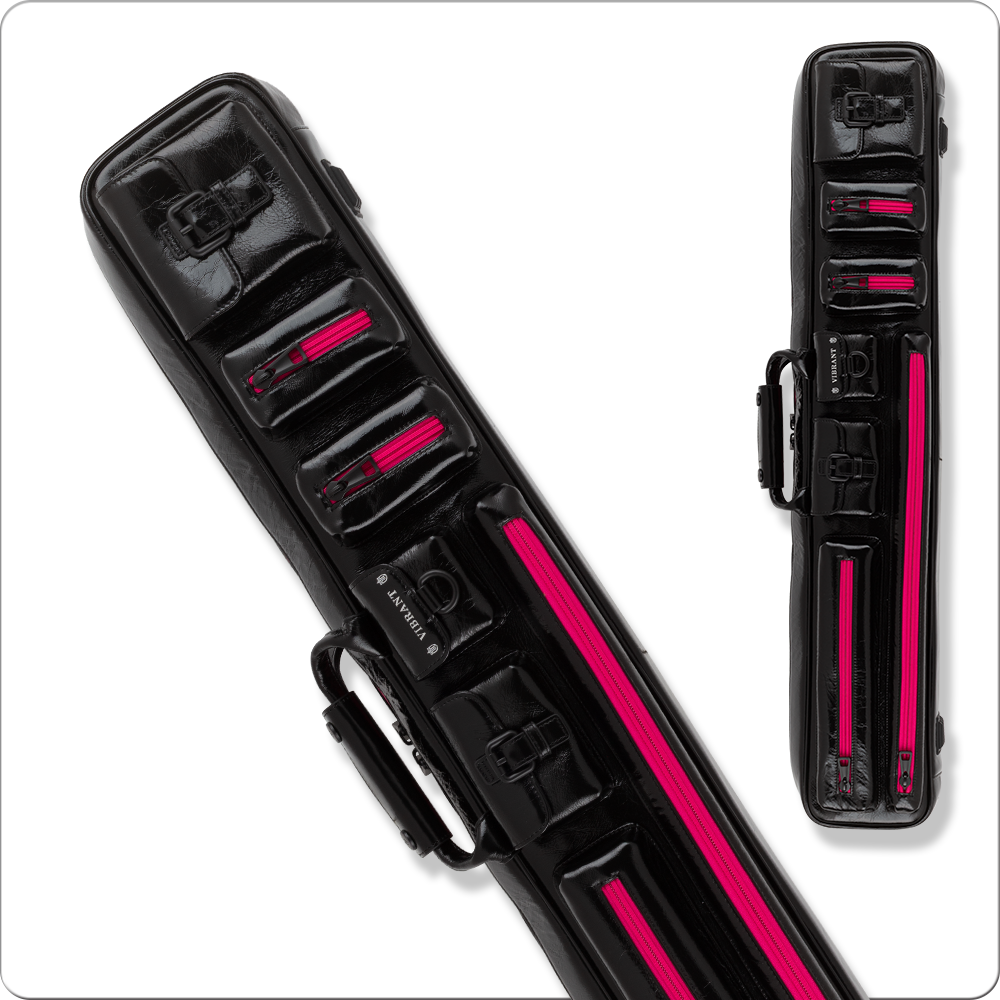
The Lizard Vibrant Series LXVMBF ($399.00) breaks from the leather and hard shell mold entirely. It’s a semi-rigid, soft-shell 3×5 built for three butts and five shafts and wrapped in bold, contemporary graphics; this version runs black with pink accents, with the same case also available in cream and black. Semi-rigid construction means less crush protection than the hard-tube Instrokes or the PRO-97 below, and that’s the tradeoff you’re making: a lighter case with a look nothing else on this list has. Lizard also makes the LXVHOLO 3×5 soft case at $350.00 in smooth black vinyl with a red interior, for players who want the Lizard fit at a lower price without the Vibrant graphics. Everything from the brand sits in the Lizard cases category.
Pro Series PRO-97 and the Instroke Premier: Value Without Giving Up the Hard Shell
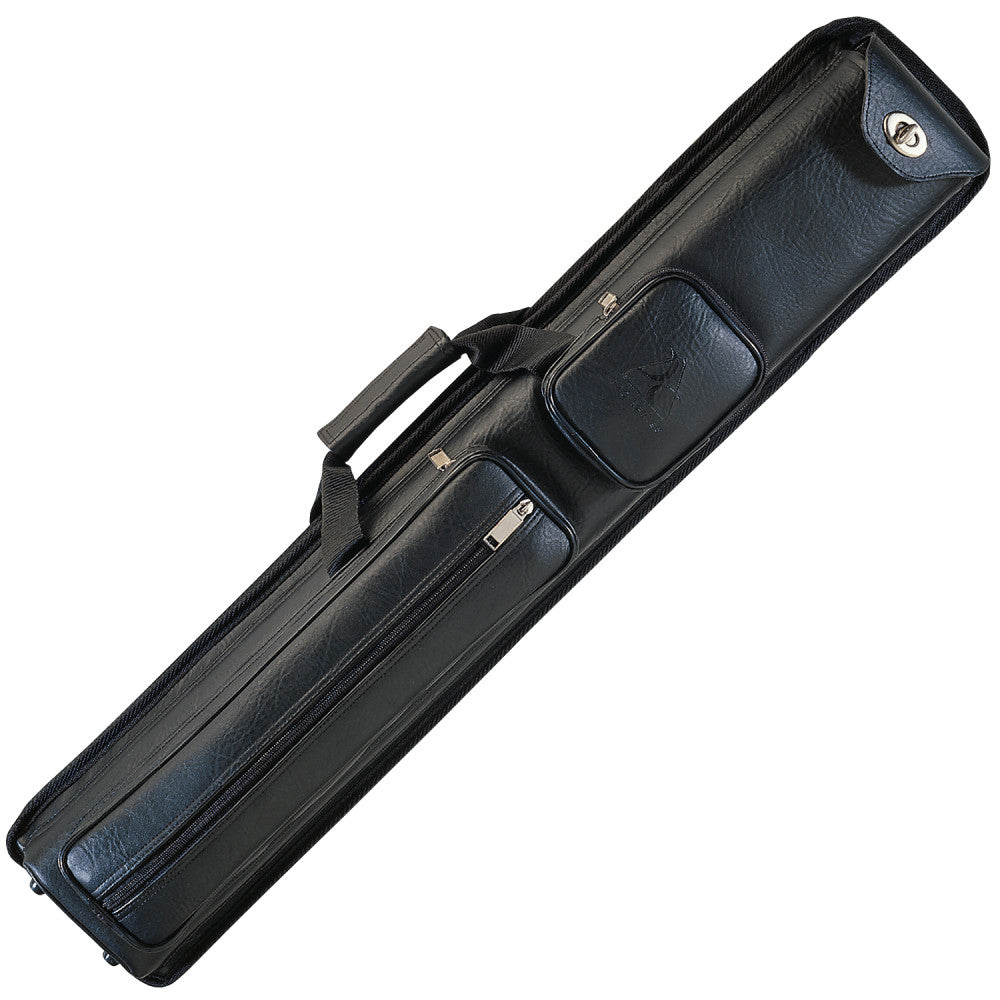
The Pro Series PRO-97 ($229.00) is the cheapest case in this comparison and still keeps the hard shell: a leatherette exterior wrapped around a hard polyform tube interior, with a reinforced carrying handle and a reinforced bottom. It’s durable and lightweight for a hard case, and it’s the one to buy when the budget is the deciding factor. Its 2×4 sibling, the PRO-96, runs $209.00 for players who don’t need the fifth shaft slot, since a 2×4 trades a butt slot and a shaft slot for a smaller, lighter case built the same way. That makes the PRO-96 the right call for a player carrying just a playing cue and a break cue, while the PRO-97 earns its extra $20.00 the moment a jump cue or a spare shaft joins the bag. The rest of the range lives in the Pro Series cases category.
The Instroke 3×5 Premier (ISPR35) at $255.20 splits the difference. It’s black vinyl instead of leather, but it keeps the same 34 inch total length, the same 31 inch shaft fit, two exterior pockets up to 16 inches, and the same shoulder strap, side handle and top handle as the Buffalo and Cowboy. If you want Instroke’s hard case dimensions and carry options without paying for leather, the Premier is the one to grab.
Featured 3×5 Pool Cue Cases
Which 3×5 Case Should You Buy
Line the five models up by price and the ladder runs $229.00 for the Pro Series PRO-97, $255.20 for the Instroke Premier, $399.00 for the Lizard Vibrant, $439.20 for the Instroke Cowboy, and $463.20 for the Instroke Buffalo, with the Instroke Southwest leather topping the range at $503.20 for players who want a second leather option. For a best value hard case, the PRO-97 wins outright: hard polyform tubes, a reinforced handle and bottom, and the lightest price tag here. For a budget Instroke, the Premier gets you the brand’s full-size hard case and three carry options for $255.20. For style and lighter carry weight, the Lizard Vibrant is the pick, as long as you’re fine trading some crush protection for a semi-rigid shell and graphics nothing else in this list has. For a leather tournament case, it comes down to color: Cowboy in black or Buffalo in brown and tan, both at hard-case spec with three ways to carry it.
A couple of numbers are worth remembering before you order. The 31 inch shaft fit on the Instroke models covers standard 29 inch shafts and 30 inch shafts with a joint protector on, so measure your actual shafts, joint protector included, before you assume a case is too small. The 34 inch total length matters too, whether you’re checking a case as luggage on a flight to a regional open or fitting it behind a truck seat on the drive there. And on any of these, orders over $99 ship free within the US.
None of these cases are a wrong choice for a 3×5 kit; they’re built for different priorities. Decide whether leather, vinyl or semi-rigid material matters most, decide what you’re willing to spend, and the five options above cover the range from a $229.00 hard case to a $463.20 leather one built to last for years.

About Corey Bernstein
Corey Bernstein is a competitive pool player, billiards equipment specialist, and co-owner of Quarter King Billiards in Wilmington, North Carolina. With over a decade of experience in the sport, Corey has competed in regional APA and BCA sanctioned tournaments and maintains an intimate knowledge of cue construction, shaft technology, and table mechanics. As a certified dealer for brands including Predator, McDermott, Jacoby, Viking, Lucasi, Meucci, Joss, and Cuetec, Corey personally tests and evaluates every cue that comes through the shop. His hands-on approach to the business means he has racked thousands of hours behind the table — breaking in shafts, comparing tip compounds, and dialing in the nuances that separate a good cue from a great one. When he is not behind the counter or on the table, Corey is researching the latest advances in low-deflection technology, carbon fiber shaft construction, and cue ball physics. His articles on Quarter King Billiards combine real-world playing experience with deep product knowledge to help players at every level find the right equipment for their game.
