 844 408 3056

 Hot Deal
Your opponent just buried you behind the eight ball, and the nine sits three rails away. Most league players see that layout and mentally concede the inning. They poke at the kick, hope for contact, and hand over ball in hand when the hope runs out. The players who beat you every week see the same layout and start counting diamonds, because kicking is not a talent. It is a set of systems, and the basic ones take an afternoon to learn.
Why Fouls Cost More Than They Used To
Almost every serious format now punishes fouls with ball in hand anywhere on the table. Against a competent shooter, ball in hand is close to a guaranteed lost rack in nine ball and a cleared category in eight ball. That math changes how valuable a decent kick becomes. You do not need to make the ball you are kicking at. You need to hit it, ideally push it somewhere inconvenient, and force your opponent to earn the rack instead of receiving it as a gift. A player who converts even half of their kicks into legal hits wins noticeably more matches without improving anything else.
The Mirror System for One-Rail Kicks
Start with the simplest tool in the box. To kick at a ball one rail away, imagine an identical table stacked on the other side of the cushion, like a reflection in a mirror. Picture the object ball sitting in that reflected table, the same distance beyond the rail as the real ball sits in front of it. Aim your cue ball straight at the imaginary ball. With no sidespin and medium speed, the cushion sends your cue ball to the real target, because the angle in equals the angle out.
Finding the mirror point without squinting
In practice you do not need to visualize a whole phantom table. Find the spot on the rail exactly halfway along the line between where your cue ball would naturally cross the cushion and the target ball, adjusted so the two angles match. Many players use the diamonds as a ruler: note which diamond the object ball is opposite, note where the cue ball is, and pick the rail point that splits the difference. Walk to the rail and stand behind the line the first few times. Your eyes are better at judging equal angles from behind the shot than from the shooting position.
Speed changes the angle more than you think
The mirror only tells the truth at medium speed with a rolling ball. Hit the same kick hard and the cue ball comes off the cushion straighter than the mirror predicts, because the rubber compresses and the ball slides through the first part of the rebound. Roll it too softly on worn cloth and the angle opens wider. When a kick must be precise, medium speed is not a suggestion. It is part of the system.
Running English Is the Kicker’s Best Friend
Sidespin that travels in the same direction the cue ball moves around the table is called running english, and it does two helpful things off a cushion. It widens the rebound angle in a predictable way, and it preserves speed instead of killing it. Most professional kicks are struck with a touch of running english precisely because the cushion behaves consistently with it. Reverse english does the opposite, shortening the angle and bleeding speed, which has its uses but punishes small errors far more.
The practical rule: when the mirror line does not quite reach your target, add a tip of running english and aim slightly shorter than the mirror suggests, letting the spin carry the ball the extra distance. When you must shorten the angle, hit firmer before you reach for reverse. Speed is easier to control than spin off a rail.
Two Rails When One Will Not Get There
Two-rail kicks look like wizardry and are mostly memory. The workhorse version runs short rail first, then long rail, out toward the far corner area, and it behaves remarkably consistently from table to table when struck with natural running english at medium pace. Spend one practice session shooting the same two-rail kick from a handful of starting positions and marking where the cue ball finishes. You are building a lookup table in your head, and that table transfers to any equipment once you learn how a given cloth adjusts it. New cloth runs long. Worn cloth runs short. Humid rooms shorten everything.
Why Your Shaft Matters More on Kicks Than Anywhere Else
Every kick struck with sidespin asks the same question: how much does your cue ball squirt off the aiming line when you apply english? On a normal shot you might be six inches from the object ball and the error stays small. On a kick, the cue ball often travels eight feet before it ever touches a cushion, and squirt error grows with every foot. This is exactly the situation low deflection shafts were built for. Less mass at the tip end means the cue ball leaves closer to the line you aimed, so the compensation you learned on Tuesday still works on Saturday.
Carbon fiber took that idea and added consistency. A shaft like the Quarter King Carbon Fiber shaft delivers low deflection performance at a working player’s price, and it never develops the humidity quirks of maple. The Predator REVO remains the reference point most players compare everything else against, while the Cuetec Cynergy 10.5mm is the choice of several touring pros who want a thinner tip for maximum spin. Players who like a slightly fuller bridge feel should look at the Jacoby BLACK V4 in 12.3mm. Any of them screws onto your existing butt, which makes a shaft upgrade the highest leverage equipment change short of a new cue. You can compare the whole field in our carbon fiber shaft collection or browse every option, wood included, in the full shaft category.

Featured Low Deflection Shafts
-

-
Quarter King Carbon Fiber Shaft
$269.99 Select options This product has multiple variants. The options may be chosen on the product page -
Sale!
-
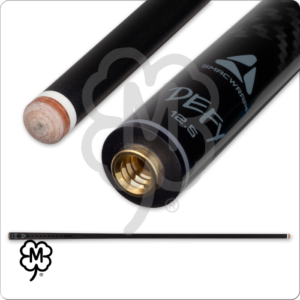
Mcdermott Defy Carbon Fiber Shaft 12.5mm
Original price was: $455.00.$432.00Current price is: $432.00. Select options This product has multiple variants. The options may be chosen on the product page -
-
PREDATOR REVO CARBON SHAFT – 5/16 x 14
$549.00 Select options This product has multiple variants. The options may be chosen on the product page -
Sale!
-
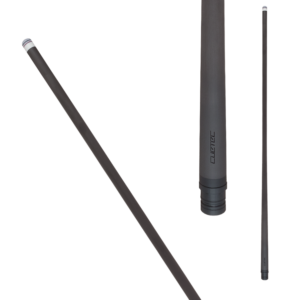
Cuetec CTCF Cynergy Cue Shaft – 10.5mm
Original price was: $499.00.$449.00Current price is: $449.00. Select options This product has multiple variants. The options may be chosen on the product page
Pick the Right Target Before You Pick the System
The biggest kicking mistake has nothing to do with angles. It is aiming at the wrong part of the ball. Before you commit to a line, decide what a good outcome actually looks like. Sometimes it is a clean hit that leaves the cue ball safe against a rail. Sometimes the smart play is kicking the object ball toward a pocket so any follow-up contact threatens to drop it. And sometimes the percentage move is a kick safety, hitting the target thin so it barely moves while your cue ball travels to the far end of the table.
Size the target honestly too. A full ball hit is a small target at distance, but a legal hit only requires touching any part of the ball, which makes the effective target nearly two ball widths wide. When the hit itself is the only requirement, aim at the center of that wide window rather than the center of the ball. When you need to move the ball somewhere specific, accept that your margin shrinks and give the shot the extra ten seconds of care it deserves. Champions treat kicks as two decisions, the outcome first and the system second. Amateurs skip straight to the system and wonder why a perfect mirror line still loses them the rack.
A Twenty Minute Kicking Practice Plan
Take ball in hand and place an object ball on the spot. Kick at it one rail from five different cue ball positions, mirror system only, no spin, medium speed. Score a point for every legal hit and play to ten before you let yourself move on. Then repeat the same five positions with one tip of running english, aiming short and letting the spin do the work. Finish with five attempts at your two-rail pattern, noting where the cue ball lands each time. Twenty minutes, three times a week, and within a month the sight of a hook stops raising your pulse.
Kicking rewards exactly the kind of player most league shooters already are: someone willing to learn a rule and apply it calmly. You do not need a hundred hours of table time. You need the mirror, a tip of running english, one memorized two-rail line, and equipment that sends the cue ball where you actually aimed it. If your current shaft makes every spin shot a negotiation, browse the full cue and shaft lineup at Quarter King Billiards and make the negotiation end.

About Corey Bernstein
Corey Bernstein is a competitive pool player, billiards equipment specialist, and co-owner of Quarter King Billiards in Wilmington, North Carolina. With over a decade of experience in the sport, Corey has competed in regional APA and BCA sanctioned tournaments and maintains an intimate knowledge of cue construction, shaft technology, and table mechanics. As a certified dealer for brands including Predator, McDermott, Jacoby, Viking, Lucasi, Meucci, Joss, and Cuetec, Corey personally tests and evaluates every cue that comes through the shop. His hands-on approach to the business means he has racked thousands of hours behind the table — breaking in shafts, comparing tip compounds, and dialing in the nuances that separate a good cue from a great one. When he is not behind the counter or on the table, Corey is researching the latest advances in low-deflection technology, carbon fiber shaft construction, and cue ball physics. His articles on Quarter King Billiards combine real-world playing experience with deep product knowledge to help players at every level find the right equipment for their game.