 844 408 3056

 Hot Deal
Quechan Casino Resort in Yuma has been loud since Thursday. The inaugural Arizona Open Pool Championship put 128 players into a single elimination bracket with a $125,000 prize fund, and the winner walks out with $25,000. Shane Van Boening showed up carrying a fresh Florida Open title. Sixty four ranked World Nineball Tour professionals filled half the draw, with 64 more competitors taking the other half. That is the event everybody is streaming.
The part worth paying attention to as a parent, a league operator, or a coach is happening on the same carpet. WNT NXTGEN, the junior arm of the World Nineball Tour, runs its Yuma stop on August 15 and 16 for players aged 16 and under. The junior field carries a $10,000 prize fund. Kids who enter also get admission to watch the Arizona Open matches, and a parent gets to come with them.
Why a Junior Bracket Next Door to the Pros Is a Big Deal
Junior pool in the United States has never suffered from a lack of talented kids. It has suffered from a lack of structure. A promising 13 year old could win a local junior event, then find nothing comparable for eight months, then age out before anybody with a camera noticed. NXTGEN is built to fix exactly that. The program runs consistent rules, formats, and prize structures across every sanctioned event, so a junior in Arizona and a junior in Europe are playing the same game under the same conditions.
Running the Yuma stop inside the Arizona Open building matters more than the prize money does. A kid who plays two matches Saturday morning and then sits twenty feet from a professional table for the rest of the day learns things no coach can hand over verbally. Watching how a pro handles a bad roll, or how long a top player takes before a critical safety, does something to a young player’s internal standard. That is a cheap education compared to what most families spend on youth sports.
The Equipment Gap Nobody Wants to Talk About
Here is the uncomfortable truth about junior pool: most kids show up holding the wrong stick. Not a cheap stick, a wrong one. A 58 inch, 19 ounce cue built for a grown adult puts an 11 year old in a stance that is physically impossible to repeat. The bridge hand ends up too far forward, the elbow flares to clear the hip, and the back hand grips somewhere near the middle of the butt because that is the only place the balance works. Then everybody blames the kid’s stroke.
Length and weight are not preferences at that age. They are the difference between a repeatable stroke and a stroke that has to be relearned every year.
Length Comes First
The quick field test: have the player get into a normal shooting stance at the center of the table with the cue tip at the cue ball. If the butt of the cue is jammed into their ribs, or if they are standing with hips rotated to make room for the backswing, the cue is too long. Junior cues in the 48 to 52 inch range let a player under about five feet tall set a bridge, drop into a real stance, and take a full backswing without contorting.
The mistake parents make is buying long on purpose so the cue lasts. It does not work that way. Two years of a bad stance costs more than a second cue does.
Weight Is About Control, Not Power
Junior cues generally run 15 to 18 ounces instead of the adult standard of 18 to 21. Lighter does not mean weaker. A lighter cue lets a smaller player accelerate the stick smoothly instead of shoving it, and smooth acceleration is what produces draw and consistent speed. Kids who fight a heavy cue develop a punch stroke, and a punch stroke follows them into adulthood.
Tip and Shaft
A 12.75mm to 13mm maple shaft with a decent layered or pressed tip is plenty at this stage. Low deflection technology is genuinely useful, but a junior who has not yet built a straight stroke will not perceive the benefit, and the money is better spent on table time. What does matter is that the tip holds chalk and gets shaped once in a while, so miscues do not teach the kid to aim center ball forever.
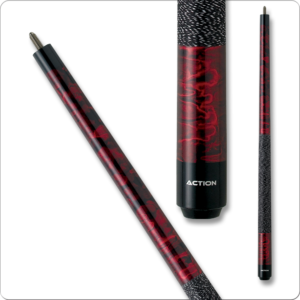
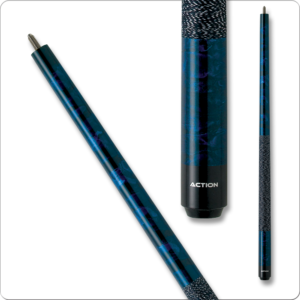
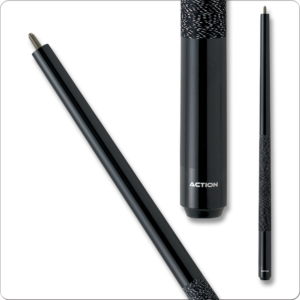
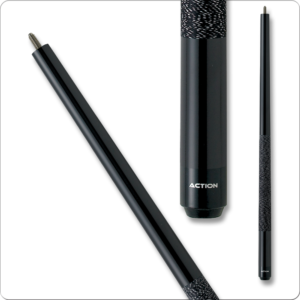
Featured Action Junior Cues
These are the cues we hand to families walking in with a nine to fourteen year old. All four are two piece, built at junior length and weight, and priced so a growth spurt does not become a financial event.
-
Sale!
-
-
Sale!
-
-
Sale!
-
-
Sale!
-
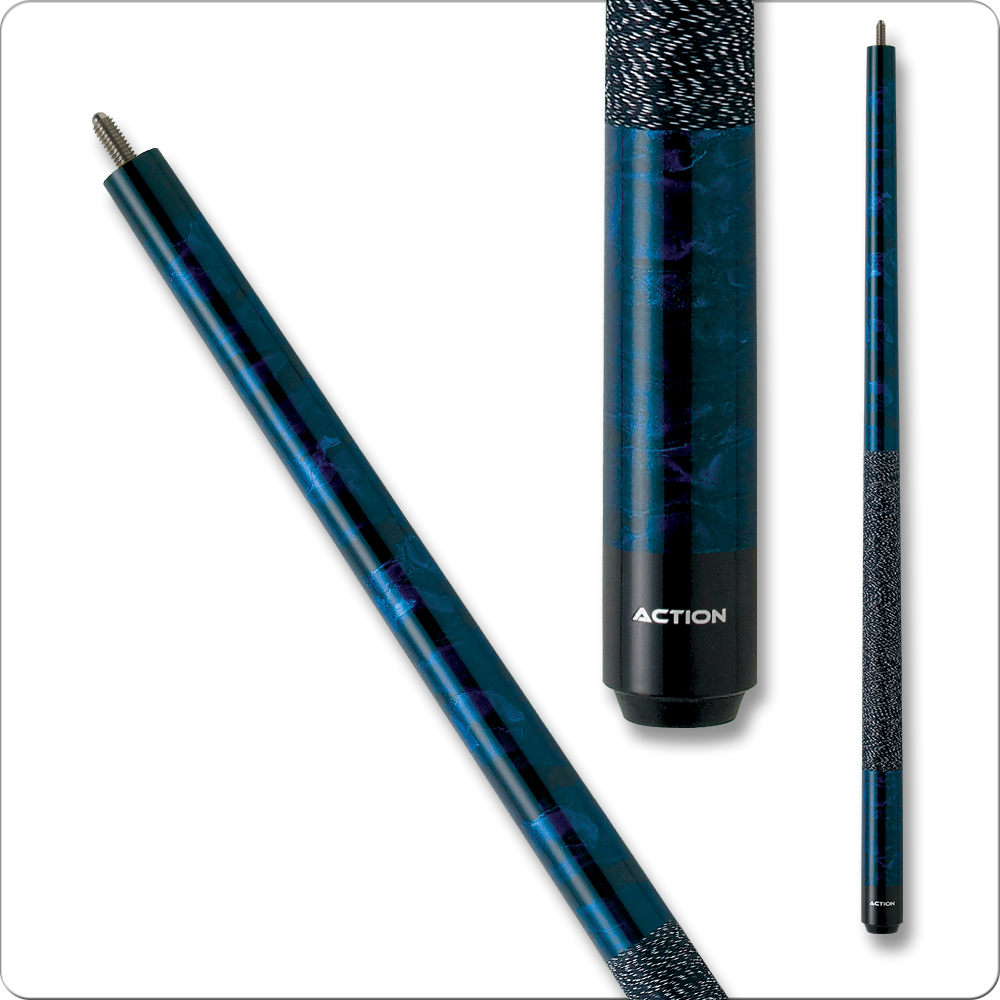
The Action JR01 Junior Cue at $112.50 and the Action JR08 Junior Cue at the same price are the two that leave the shop most often, mostly because the graphics actually appeal to kids, and a cue a kid likes is a cue a kid carries. The Action JR12 Junior Cue and Action JR03 Junior Cue sit at $103.50 and do the same job.
For a player who is still very small, or for a house table where kids and adults share equipment, a short one piece cue is a smarter purchase than a junior two piece. The Action ACTO48 One Piece Cue at $42 and the Action ACTO42 One Piece Cue at $40 cover the 42 and 48 inch range without any real financial commitment.
When a Junior Should Move to a Full Size Cue
The transition is not about a birthday. It is about three things happening at once.
The stance stops changing. When a kid can walk to a shot and land in the same stance twice without thinking, the body has locked in a pattern. Changing cue length before that point resets the pattern.
The bridge hand reaches comfortably. If the player can bridge for a center table shot without stretching onto their toes, the table has stopped being oversized for them.
The cue starts feeling short on long shots. This is the honest signal. Juniors who have outgrown their cue start choking up at the very back of the butt to get more reach. When you see that, it is time.
Most players make the jump somewhere between 5’2″ and 5’5″, which lands anywhere from age 12 to age 15. When that day comes, a starter cue in the $100 to $250 range is the right next step, not a $600 cue. Our starter cues section is built around exactly that jump, and the broader pool cues catalog handles everything after it.
Practice That Fits a Kid’s Attention Span
Junior players do not need two hour sessions. They need short sessions with a scoreboard. Three drills cover most of what a young player is missing.
Straight in from the spot, ten in a row. Cue ball and object ball both on the long string, object ball on the foot spot. Pot it and stop the cue ball dead. Count how many in a row before the streak breaks, then write the number down. Kids chase their own numbers relentlessly.
The line of nine. Nine balls spread across the table one diamond apart. Run them in order with ball in hand only on the first shot. This teaches pattern thinking without the complexity of a full rack.
Speed ladder. Shoot the cue ball from the head rail and try to stop it at a specific diamond going up the table. One rail, two rails, three rails. Speed control separates juniors who plateau from juniors who keep climbing, and it is nearly impossible to teach through instruction alone.
What to Watch This Weekend
The Arizona Open wraps on Sunday, and the NXTGEN Yuma bracket plays out Saturday and Sunday alongside it. If you have a junior who is even mildly serious about the game, put the stream on in the house. The point is not the winner. The point is that a 14 year old somewhere in North Carolina sees a bracket with kids their age in it, attached to a real tour with real structure, and starts thinking the whole thing is possible.
That thought is worth more than any cue we sell. But when they do need the cue, get one that fits.

About Corey Bernstein
Corey Bernstein is a competitive pool player, billiards equipment specialist, and co-owner of Quarter King Billiards in Wilmington, North Carolina. With over a decade of experience in the sport, Corey has competed in regional APA and BCA sanctioned tournaments and maintains an intimate knowledge of cue construction, shaft technology, and table mechanics. As a certified dealer for brands including Predator, McDermott, Jacoby, Viking, Lucasi, Meucci, Joss, and Cuetec, Corey personally tests and evaluates every cue that comes through the shop. His hands-on approach to the business means he has racked thousands of hours behind the table — breaking in shafts, comparing tip compounds, and dialing in the nuances that separate a good cue from a great one. When he is not behind the counter or on the table, Corey is researching the latest advances in low-deflection technology, carbon fiber shaft construction, and cue ball physics. His articles on Quarter King Billiards combine real-world playing experience with deep product knowledge to help players at every level find the right equipment for their game.