Ask a room full of league players what game they play and almost nobody says straight pool. Ask the best player in that room where they learned position and there is a decent chance the answer involves 14.1. The game has fallen out of tournament fashion, but it remains the single most efficient teacher of cue ball control in pool, and it is almost free to practice because you need nothing but a table and a rack.
Here is how it works, why the structure of the game produces better players, and what to practice first.
The rules, in plain language
Straight pool, also called 14.1 continuous, is a call shot game. You name a ball and a pocket, and if it goes where you said, you get one point and you keep shooting. Any ball is legal at any time. There is no rotation, no suit, no order. Match totals are agreed in advance, commonly 100, 125, or 150 points.
The defining mechanic is in the name. You shoot the rack down to one remaining object ball, and then the fourteen pocketed balls are re-racked into the triangle with the apex spot left empty. The one ball still on the table is your break ball, and your job is to pocket it in a way that sends the cue ball into the fresh rack and springs a few balls loose. Do that well and your run continues without interruption. Fail and the table is frozen in front of you.
The opening break is unusual too. On the first shot of the game you must either pocket a called ball or drive two object balls plus the cue ball to a rail. Miss that requirement and it is a two point penalty, and your opponent can make you shoot again. Three consecutive fouls costs fifteen points and a re-rack. These penalties exist because without them the correct opening move would be to do nothing at all.
Why the game builds players
In 9-ball you are told what to shoot. The rack dictates the order and your only decision is how to get there. That is a real skill, but it is a narrow one.
In straight pool nothing is dictated. Fifteen balls sit there and you choose the sequence. Every shot has an obvious answer and a correct answer, and they are frequently different. The obvious answer is the easiest ball. The correct answer is the ball that leaves you shape on the next three. A run of forty requires you to be thinking three to four balls ahead continuously, and the game punishes short term thinking immediately and visibly.
There is also the matter of scale. A 9-ball rack gives you nine chances to make a mistake and then resets. A straight pool run gives you unlimited chances, which means your errors accumulate into a number you cannot argue with. If you run 18 and stall, the reason is written on the table.
Key balls and the architecture of a run
Two concepts hold a run together, and neither exists in rotation games.
The break ball is the last ball of the rack, and it must be positioned so that pocketing it drives the cue ball into the new rack at an angle. A break ball sitting directly below the rack is useless. You want it out to the side, roughly level with the second or third row, so you can send the cue ball into the side of the stack and come back out. Good players identify their break ball when eight or nine balls remain and protect it for the rest of the rack.
The key ball is the ball you shoot immediately before the break ball, and its only job is to deliver you the correct angle on the break ball. It is a setup shot, and it is chosen entirely for where it leaves you rather than how easy it is.
Once you internalize this, you start seeing rotation games differently. The key ball concept is exactly what separates a 9-ball player who runs out from one who gets to the 7 and then needs a miracle.
Featured Pechauer Products


The cue question, answered honestly
Straight pool does not reward the same equipment that 9-ball does. You almost never need a power draw shot across the table. You need to move the cue ball eighteen inches, precisely, four hundred times in a row, and you need the cue to do the same thing every time you deliver it.
This is why straight pool players historically gravitated toward solid maple shafts rather than the lowest deflection option available. A low deflection shaft is a genuine advantage when you are applying heavy sidespin at speed. Most straight pool is played with centre ball and soft speed, where the advantage largely disappears and consistency of feel matters more.

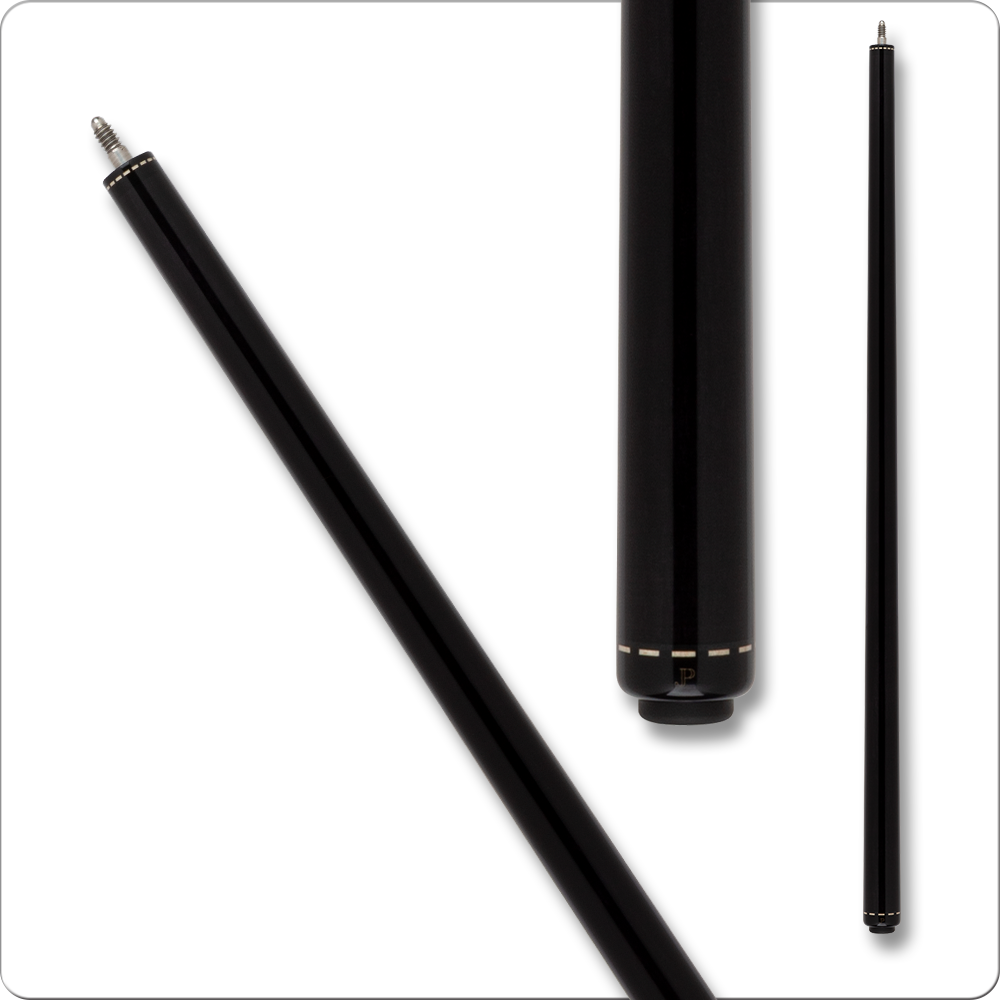
Pechauer, built in Green Bay, Wisconsin, has been making that kind of cue since 1978, and their range covers the useful price band almost exactly. The Pechauer JP2501 at $324 is the entry point, with a classic wood shaft and the company’s ICE shaft treatment. The JP2503 at $378 adds a brown build with more inlay work at the same playing spec.
Step up to the Pro Series and the specification gets more specific. The Pechauer JP25R04 at $450 pairs a 12.75mm Pechauer Jade medium tip with a 5/8 inch Juma ferrule, a 29 inch hard rock maple shaft with a 10 to 12 inch pro taper, and the Pechauer speed joint. That tip diameter is worth noting. A 12.75mm tip is slightly smaller than the 13mm standard, which sharpens your contact point feedback without going to the extremes of a 11.75mm carbon setup. For a game built on precise centre ball contact, that is a sensible middle.
The JP2518 at $585 sits at the top of the practical range. None of these will run more balls for you than the JP2501 will. What you are buying above the entry model is fit and finish, and the honest advice is to spend the difference on table time.
Three drills that transfer immediately
The fourteen ball progressive run
Rack fifteen, break, and simply try to run as many as you can with proper re-racks. Write the number down every time. Do not restart when you miss, and do not take the shot again. The number is the drill. Most league players discover their honest high run is somewhere between 8 and 20, which is humbling and useful. Watch it climb over a few months.
Break ball isolation
Set up a break ball in a good position, put nine other balls on the table randomly, and run the nine while keeping the break ball untouched. This teaches you to protect a resource across an entire sequence, which is precisely the discipline that 8-ball pattern play demands when you have to save a ball near a pocket for last.
Centre ball only
Run a rack using nothing but centre ball, stop, follow, and draw. No sidespin at all. Most players are shocked at how much of the table is reachable without English, and how much of their normal sidespin use is a substitute for correct angle selection rather than a genuine requirement.
The records, for perspective
Willie Mosconi ran 526 consecutive balls in a 1954 exhibition at the East High Billiard Club in Springfield, Ohio, and that figure is still the most widely cited high run in the game. John Schmidt recorded a 626 ball run in 2019 under practice conditions, documented on video, which stands outside the traditional exhibition record framework but is the highest verified run anyone has produced.
Numbers like that are not the point. The point is that a game exists where the ceiling is effectively unlimited, which means every session gives you a direct and unforgiving measurement of how well you are actually controlling the cue ball. Nothing in 9-ball does that.
Spend a month on straight pool and go back to your regular game. The pattern recognition transfers, the speed control transfers, and you will find yourself looking three balls ahead without deciding to.
See the full pool cue range at Quarter King Billiards, or browse the Pechauer collection in detail.

About Corey Bernstein
Corey Bernstein is a competitive pool player, billiards equipment specialist, and co-owner of Quarter King Billiards in Wilmington, North Carolina. With over a decade of experience in the sport, Corey has competed in regional APA and BCA sanctioned tournaments and maintains an intimate knowledge of cue construction, shaft technology, and table mechanics. As a certified dealer for brands including Predator, McDermott, Jacoby, Viking, Lucasi, Meucci, Joss, and Cuetec, Corey personally tests and evaluates every cue that comes through the shop. His hands-on approach to the business means he has racked thousands of hours behind the table — breaking in shafts, comparing tip compounds, and dialing in the nuances that separate a good cue from a great one. When he is not behind the counter or on the table, Corey is researching the latest advances in low-deflection technology, carbon fiber shaft construction, and cue ball physics. His articles on Quarter King Billiards combine real-world playing experience with deep product knowledge to help players at every level find the right equipment for their game.
